Most fine retailers manage return rate the way they manage shrinkage — as a leak to be plugged. Tighter policy, restocking fees, an online return flow with just enough friction to discourage anyone from starting one. On commodity goods, that’s defensible. On a $5,000 ring or a $25,000 watch sold through an advisor, it’s one of the most expensive mistakes you can make.
This playbook reframes the high-AOV return — not as a loss to suppress, but as a trust deposit that, handled well, compounds into the next purchase, the upgrade, and the referral. Here’s how to run it.
Why The Return Rate Misleads
“Return rate” is an average, and it averages together two populations that have nothing in common:
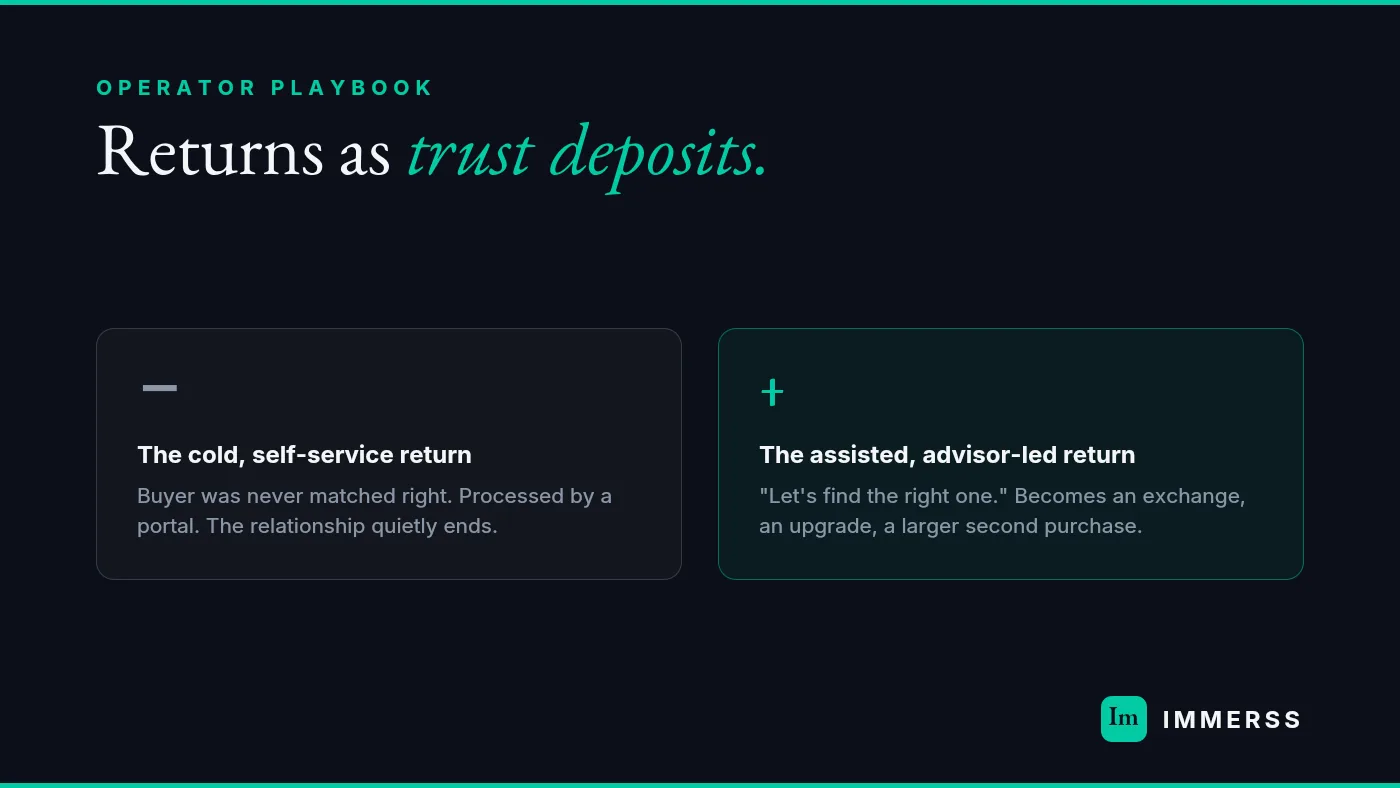
| Cold / self-service return | Assisted / advisor-led return | |
|---|---|---|
| What it signals | Buyer was never properly matched | Mid-relationship recalibration |
| Typical outcome | Clean refund, customer churns | Exchange or upgrade, customer stays |
| Emotional register | ”Stuck with the wrong thing" | "Help me find the right one” |
| Cost that matters | Logistics (real, but small) | Relationship (large, often invisible) |
| What to do with it | Fix the matching upstream | Protect and resource the interaction |
When you manage both as one number, you optimize against the assisted return — the profitable one — to suppress the cold one. You make the relationship-building return colder and slower in the name of a metric that was only ever a problem for the other cohort.
The Three Layers Of A High-AOV Return
A return on a high-consideration piece runs through three layers. Most retailers only operate the first.
1. The logistics layer. RMA, label, inspection, restock. This is where self-service flows live, and it’s the only cost a commodity return flow is built to manage. On a $15K piece it’s a rounding error. Automate it — an AI sales agent can surface the order and handle the mechanics without friction — but don’t mistake it for the whole job.
2. The diagnosis layer. Why is it coming back? Size, proportion, expectation, occasion, second thoughts. This is invisible to a portal and obvious to the advisor who sold the piece. The diagnosis is what turns a refund into a re-match.
3. The re-match layer. “Let me show you two emerald cuts before you decide anything.” This is where a return becomes a fitting, a refund becomes an exchange, and a hesitant buyer becomes a known customer. It only exists if a person is in the loop.
The website processes layer one and skips two and three entirely. That’s the whole problem.
The ICP Filter — Who This Applies To
This playbook is written for a specific operator. Run it against your business:
- Shopify Plus, 50K+ monthly visits, AOV $100+ — sweet spot $500+, decisive at $5,000+. The higher the AOV, the more the return is the product.
- A consultative sales motion already in place, or wanted — advisors, not order-takers.
- A return rate you currently treat as a problem — especially if you’ve been adding friction to suppress it.
- A suspicion that good customers are quietly not coming back after a cold return, with no obvious cause on the dashboard.
If that’s you, your return flow is probably leaking relationships, not just inventory — and the fix is structural, not a policy tweak.
What To Measure Instead Of Return Rate
Replace the single leak metric with three relationship metrics on assisted sessions:
- Exchange-to-refund ratio. An exchange is a relationship continuing; a refund is, more often, one ending. On assisted sessions this should run meaningfully higher than on self-service.
- Second-purchase rate among returners. Track what returners do next. Met well, they come back — frequently at a higher AOV.
- Net relationship value, not gross return cost. Book the assisted return against the lifetime value of the customer it retains, not as a standalone loss.
A higher return rate on assisted sessions, paired with a high exchange ratio and strong second-purchase rate, is not a warning light. It’s the model working.
The 60-Day Pilot, On Us
The fastest way to see whether your high-AOV returns are leaking relationships is to put a human in the loop at the return point and watch what changes. That’s what the pilot is for.
We run a structured 60-day pilot, on us — an AI sales agent handling the logistics layer without friction, live one-to-one video consultation available at the diagnosis and re-match layers, and measurement built around exchange ratio and second-purchase rate rather than gross return rate. You publish nothing, change no policy, and risk no margin to find out whether your assisted returns are quietly building relationships you’re currently throwing away.
Brands running consultative sessions through Immerss typically see assisted interactions run above baseline on exactly the relationship measures above. We frame that as a benchmark, not a promise — the point of the pilot is to find your number, on your inventory, with your advisors.
Immerss is a luxury live commerce platform — AI sales agents and one-to-one video consultation for fine jewelry, watches, and high-AOV retail, built on Shopify Plus.
See the pilot for merchants: landing.immerss.live Agency partner program: partners.immerss.live