Discounting is the universal reflex for a hesitant buyer, and for luxury ecommerce and high-AOV retail it’s the most expensive thing an online store can do — because almost all of the cost is invisible. It never shows up on the P&L. It shows up later as full-price sales that didn’t happen, a brand that lost pricing credibility, and a customer base that learned to wait for the next promotion.
This playbook breaks down the true cost of discounting, explains why ecommerce operators reach for the markdown anyway, and lays out the one alternative to discounting that closes hesitant high-AOV buyers at full price: guided, one-to-one consultation — the lever the website took away.
Why discounting hurts luxury brands: the visible math lies
The discount feels rational because the in-the-moment comparison is rigged: “ninety percent of a sale beats a hundred percent of no sale.” That comparison counts only the two visible outcomes — discounted sale versus lost sale — and ignores everything the markdown does afterward.
Discounting isn’t an isolated pricing event. It’s a system that reshapes customer behavior, brand meaning, and which axis your store competes on. For a fine jewelry retailer, a watch dealer, or any Shopify Plus store selling considered, high-AOV products, the downstream effects of promotional pricing are larger than the margin given away on the single sale. Put those effects in the frame and the math inverts.
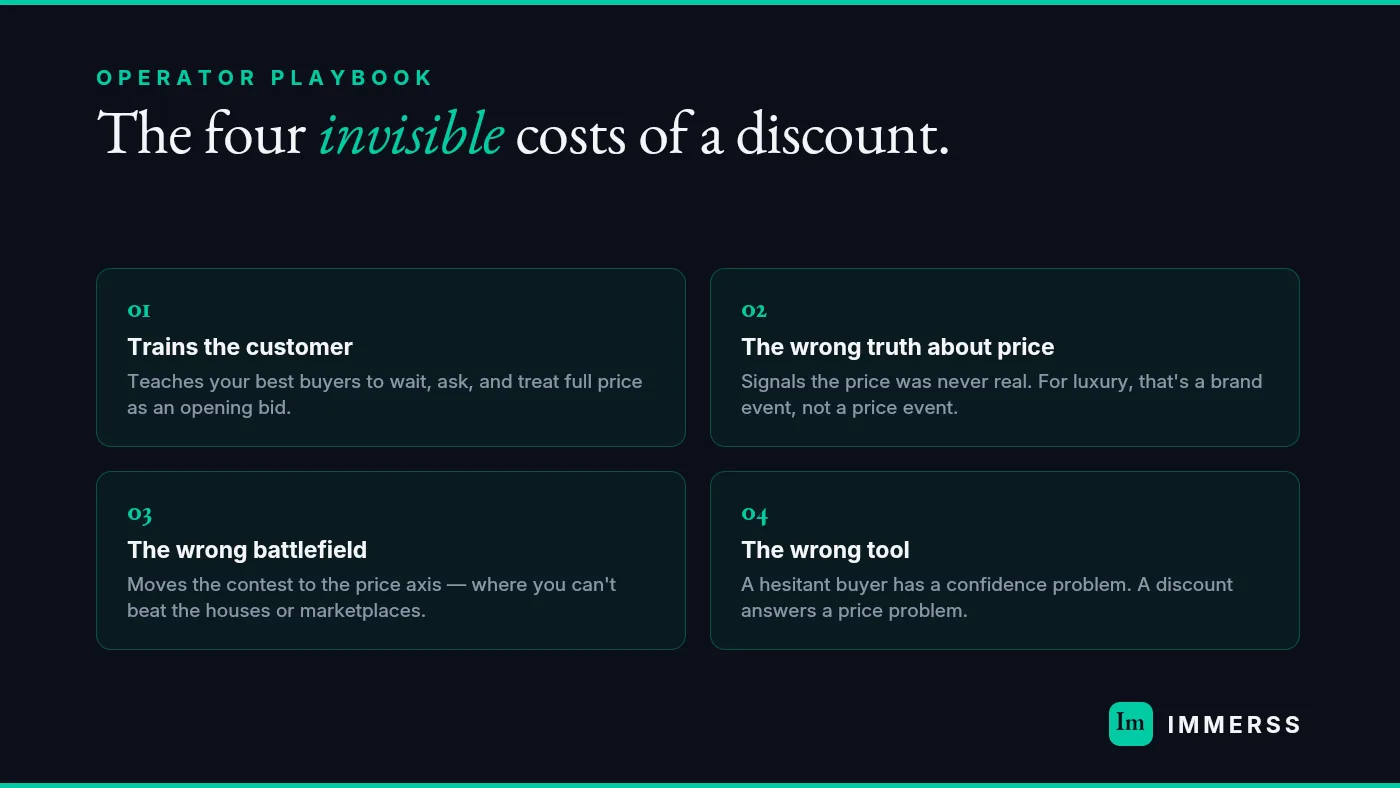
The true cost of discounting: four invisible costs
| Cost | What it does | Why it’s expensive |
|---|---|---|
| Trains the customer to wait | Teaches buyers to ask for discounts and treat full price as an opening bid | A loan against future margin — repaid on every later sale they now expect to discount |
| Destroys price integrity | Signals the price was never real | In luxury retail, price is part of the product; a markdown is a brand event, not a price event |
| Moves you to the wrong battlefield | Shifts the contest onto the price axis | You can’t out-discount the houses, marketplaces, or gray market — and your real strengths are invisible there |
| Solves the wrong problem | Treats a confidence problem as a price problem | The buyer hesitated from uncertainty, not price; the discount closes a sale they weren’t confident in |
In plain terms: every reflexive markdown trains customers to wait for sales, tells the market your pricing was fiction, drags your store into a price war it cannot win, and papers over the real reason the customer hesitated.
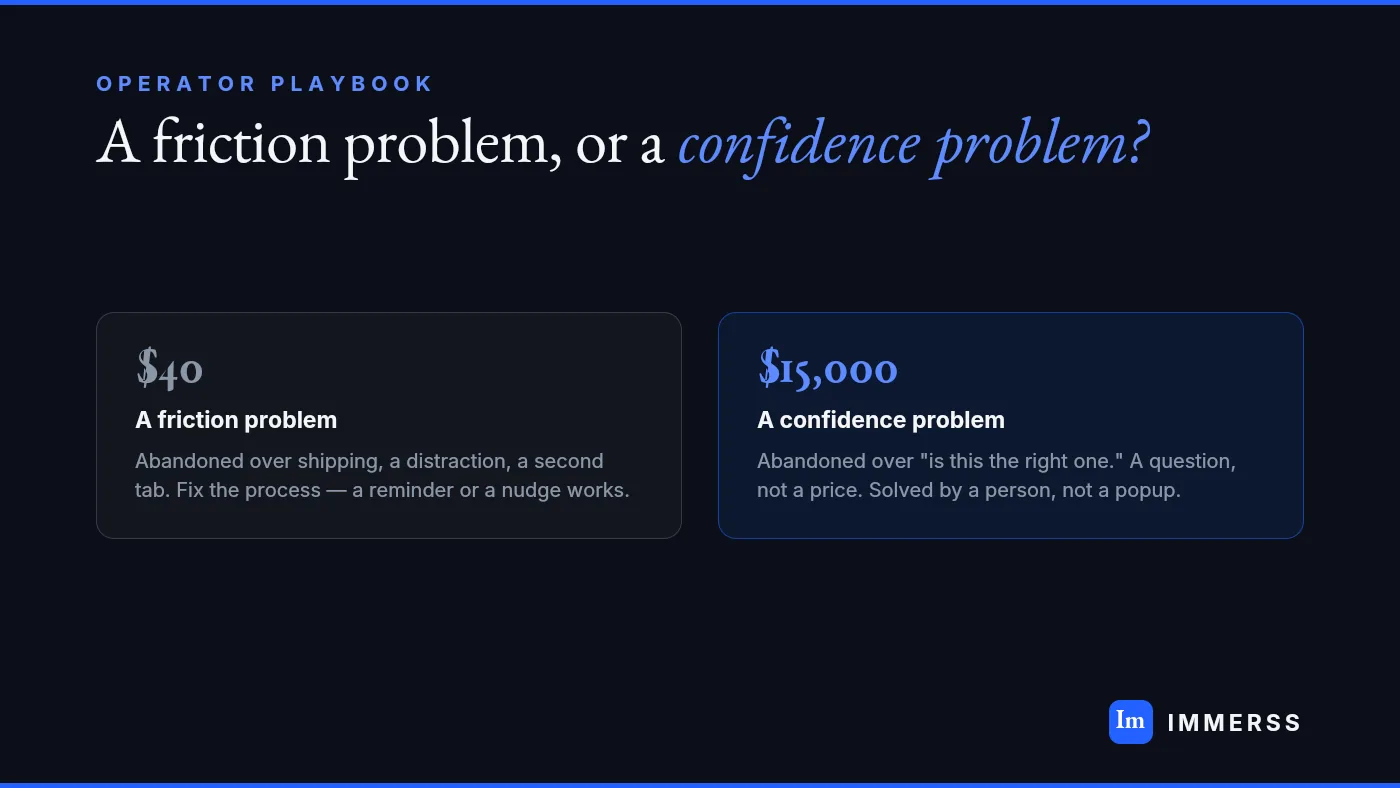
That last cost is the deepest. A buyer deliberating over a $15,000 piece isn’t a few percent away from yes — they’re uncertain. Is this the right piece? Will it suit me? Can I trust this store with this much money? Those are confidence questions. The discount answers the wrong one.
A worked example: what a 10% discount really costs
Take a single $15,000 sale at a typical fine jewelry margin. A 10% markdown costs $1,500 today — visible, bounded, easy to accept.
Now follow the same customer forward. High-AOV jewelry and watch clients are repeat buyers: anniversaries, milestones, collecting. Suppose this client makes three more purchases over the next three years at a similar AOV. Having learned that hesitation produces a discount, they now wait — or ask — every time. Three more markdowns at 10% is another $4,500. The “one-time” save is now a $6,000 loan against your own margin.
And that’s one customer. Multiply by every hesitant buyer your team closed with a markdown this year, add the buyers who saw the promotion and re-anchored on the discounted price, and the true cost of discounting stops being a line item and becomes a structural drag on full-price conversion. Discount-heavy stores aren’t cheaper to run — they’re quietly repricing their entire future catalog downward.
The compounding spiral: how markdowns become the only lever
The four costs don’t just add up — they compound into each other. Training customers to wait increases the share of buyers who hesitate for a discount, which increases how often you reach for the markdown, which trains more customers, which erodes the brand’s pricing credibility, which moves you further onto the price axis, which makes guidance-based selling feel even less available — so price becomes, more and more, the only lever you ever pull.
Left unchecked, a fine retailer can discount their way from a relationship business into a margin-compressed price business without ever making a single decision that felt wrong in the moment. Each markdown was a sensible save. The spiral is the sum of them.
Why ecommerce defaults to discounting: a tools failure, not a discipline failure
If discounting is this expensive, why do experienced operators keep reaching for it? Because when a customer hesitates online, the website hands the operator essentially one lever to move them: price. There is no advisor in the browser to read the hesitation, answer the real question, and guide the customer to confidence. So the operator turns the one knob the channel left them.
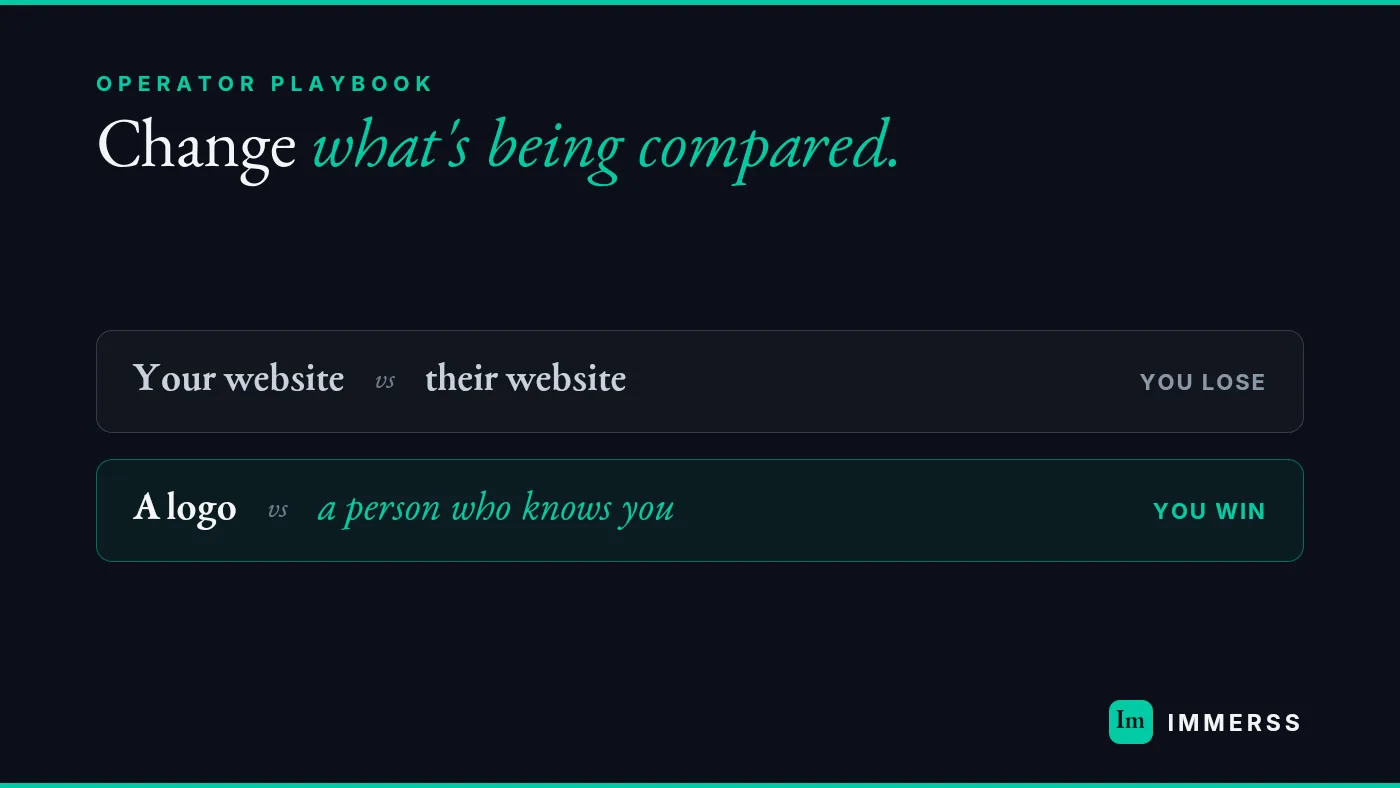
In a store, there was a better lever. When a customer hesitated over a serious piece, a great advisor didn’t drop the price — they understood the doubt and guided the customer to a confident yes at full price. The store closed on guidance; the website closes on discount, because guidance was the first thing ecommerce stripped out.
This is the same gap we’ve written about in Digital Clienteling for the Modern Age: the highest-converting behavior in luxury retail — a trusted human reading a specific customer’s hesitation — was never ported online. The discount trap is what happens when you remove every lever except price.
Are you in the discount trap? A quick self-assessment
Run this against your store:
- Shopify Plus, 50K+ monthly visits, AOV $100+ — sweet spot $500+, decisive at $5,000+. The higher the AOV, the more the hesitation is a confidence gap, not a price gap.
- You discount to close hesitant buyers — reflexively, repeatedly, not just to clear genuine dead stock.
- Customers increasingly ask for, or wait for, a discount. The training is already underway.
- Strong in-store conversion, weak online conversion. The store has the guidance lever; the website only has price.
If two or more are true, you’re using a price tool to solve a confidence problem — and paying all four invisible costs for it.
How to close hesitant buyers without a discount: put the guidance lever back
The alternative to discounting is not “hold the line and lose the sale.” It’s restoring the other lever: live, one-to-one video consultation that does online what the great advisor did in the store — engage the hesitation, answer the question behind the question, and guide the buyer to a confident yes at full price.
In practice the workflow looks like this on a Shopify Plus store:
- An AI sales agent engages the hesitating visitor — not as a chatbot deflecting tickets, but as a qualifier that recognizes high-intent, high-AOV hesitation and answers first-layer questions.
- The agent escalates qualified buyers to a live human advisor over one-to-one video — the digital equivalent of the moment a floor associate walks over.
- The advisor closes on confidence, not price — sizing, provenance, styling, comparison between pieces, the reassurance that a five-figure decision deserves.
It works because it solves the actual problem — converting uncertainty into confidence — instead of marking down a decision the customer wasn’t sure of. And the economics run the opposite direction from discounting:
- Full margin preserved — you close without touching the price.
- Brand and price integrity intact — no signal that the price was a fiction.
- No training to wait — the customer learns you guide, not that you bend.
- Higher AOV, not lower — a trusted advisor guides to the right piece, not the cheapest one. Discounting pushes AOV down; guidance pushes it up. Brands running consultative selling through Immerss have documented up to a 35% lift in AOV on guided sales, alongside a 28% lift in conversion.
When is discounting okay for luxury ecommerce?
Be precise so this doesn’t curdle into dogma. There are three legitimate uses of the markdown:
Clearing genuinely dead stock. A clearance is an honest exit from inventory — discontinued lines, broken size runs — not a tool for closing live sales on current product. The distinction is the product, not the percentage.
A rare, brand-consistent event. An infrequent private event for established clients can build goodwill — provided it’s rare enough not to train the wait and framed as relationship, not promotion.
A deliberately value-positioned business. If your model is built on price leadership, promotional pricing is your strategy, not your trap. This playbook is for stores whose brand depends on price meaning something.
The trap is the reflexive, repeated use of discounting to close hesitant high-AOV buyers. That’s the pattern that compounds.
How to measure the shift to full-price selling
Three numbers tell you whether guidance is replacing the markdown:
- Full-price conversion rate: assisted vs. unassisted sessions. Shows what guidance closes that discounting can’t.
- AOV: guided sales vs. discounted sales. Tells you which lever builds the business and which spends it down.
- Discount dependency rate — the share of high-AOV sales that required a markdown to close. The number you want falling, month over month.
If your store struggles with abandoned high-value carts specifically, the same guidance lever applies there — see How To Recover The Stuck Buyer Hiding In Your Window-Shopper Cohort for the recovery-side version of this playbook.
FAQ: discounting and full-price selling in luxury ecommerce
Does discounting devalue a luxury brand?
Yes — and faster than most operators expect. In luxury retail, price is part of the product: it signals scarcity, quality, and confidence. A reflexive markdown tells the customer the price was negotiable all along, which re-anchors their reference price downward and makes every future full-price ask harder. One clearance of dead stock won’t damage a brand; a pattern of discounting to close hesitant buyers will.
How do I get customers to stop waiting for sales?
Stop teaching them that waiting works, and give them a better reason to buy now: confidence. Replace the markdown with guided consultation — a live advisor who resolves the actual hesitation (fit, authenticity, comparison, trust) — and hold pricing steady long enough for the new pattern to register. Customer retraining is slower than customer training; expect the discount-request rate to fall over months, not weeks, and track it explicitly.
What is the best alternative to discounting in ecommerce?
For high-AOV products, the highest-leverage alternative is live one-to-one consultation, because it addresses the real cause of hesitation. Adjacent tactics — payment installments, white-glove delivery, strong guarantees — reduce friction, but only guidance converts uncertainty into confidence. An AI sales agent qualifying buyers and routing them to a human advisor over video makes this scalable on a Shopify Plus store.
Why is my in-store conversion higher than my online conversion?
Because the store has an advisor and your website doesn’t. In-store, hesitation is met by a human who reads it and resolves it; online, the same hesitation is met by silence — or a discount popup. The gap between your in-store and online conversion on high-AOV items is a rough measure of how much guidance is worth in your business.
Does live video consultation actually convert for jewelry and watches?
Considered, emotional, high-trust purchases benefit most from guidance. Brands running consultative sessions through Immerss typically see assisted high-AOV interactions convert meaningfully higher at full price than self-service browsing — with documented results up to a 28% conversion lift and 35% higher AOV on guided sales. We frame those as benchmarks, not promises: the pilot below finds your number, with your advisors, on your inventory.
The 60-day pilot, on us
The fastest way to see the other lever work is to put live consultation in front of your hesitant high-AOV buyers and measure full-price conversion against your discount-dependent baseline. That’s what the pilot is for.
We run a structured 60-day pilot, on us — an AI sales agent engaging and qualifying hesitant buyers, live one-to-one video consultation as the lever that closes them at full price, and measurement built around full-price conversion, guided-sale AOV, and discount dependency rate. You change no pricing and risk no margin to find out whether the discounts you’ve been giving were ever a price problem — or a missing advisor.
See the pilot for merchants: landing.immerss.live Agency partner program: partners.immerss.live
Immerss is a luxury live commerce platform — AI sales agents and one-to-one video consultation for fine jewelry, watches, and high-AOV retail, built on Shopify Plus.