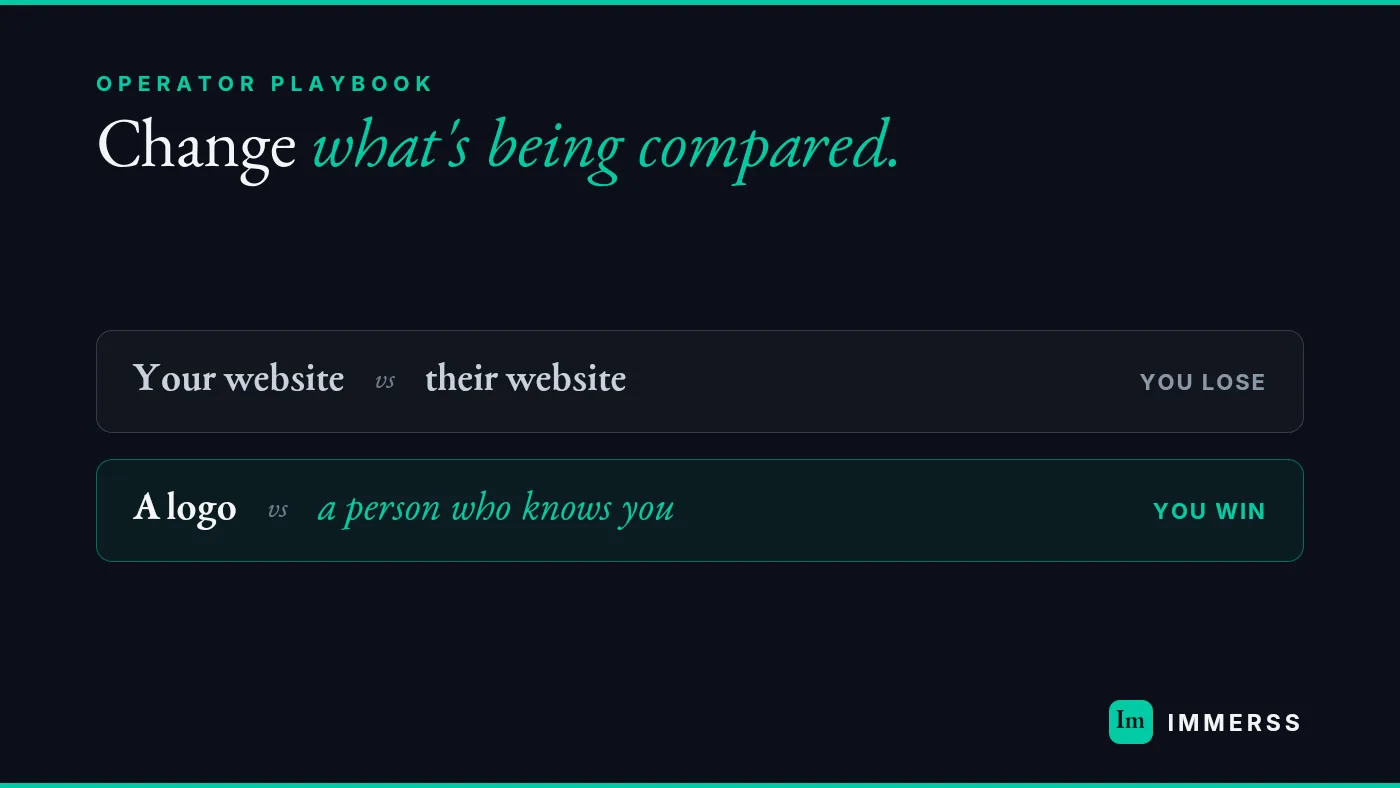
Every independent fine retailer competes against the global houses — not on the showroom floor, but in the customer’s head, on a screen, before the customer ever arrives. The houses have spent fifteen years and enormous budgets setting the default expectation for what shopping for a serious piece looks like. Land on an independent’s site, and the customer is already comparing it to that default.
On polish, breadth, and production value, the independent loses — not because they’re worse, but because they’re outgunned by orders of magnitude. This playbook is about getting out of that losing comparison by changing what is being compared.
Two axes — and you only win on one
| The axis the houses set | The axis you actually win on | |
|---|---|---|
| What’s compared | Website vs. website | A logo vs. a person who knows you |
| Wins on | Budget, scale, polish, breadth | Relationship, memory, guidance |
| Who’s favored | The conglomerate, always | The independent, structurally |
| Can the other side follow? | You can’t outspend them | They can’t scale a real relationship |
| Right strategy | Don’t compete here | Move the whole contest here |
As long as the customer is comparing two catalogs, you’re in the shadow and you lose. The entire strategic problem is to move the comparison onto the axis where you win decisively.
The trade the houses made
The houses’ digital dominance was not free. It was bought with a trade — and the thing they traded away is your native advantage.
To run hundreds of stores across dozens of countries, a house must be consistent and impersonal by necessity. A thousand stores cannot deliver a thousand genuine, named, one-to-one relationships — the relationship doesn’t scale. So the house substitutes the one thing that does: the brand. The logo becomes the relationship; it carries the trust that, in your store, is carried by a person.
That trade has a cost. There is no one at the house’s website who remembers your customer’s last purchase, knows their preferences, or can gently steer them from the piece they’re drawn to toward the one that’s actually right. The scale that makes the houses unbeatable on polish makes them structurally incapable of the relationship you offer by default.
The ICP filter — is this your fight?
Run this against your business:
- Shopify Plus, 50K+ monthly visits, AOV $100+ — sweet spot $500+, decisive at $5,000+. The higher the AOV, the more the relationship outweighs the logo.
- You’re an independent or small group — not a scaled chain. Your advantage is the named advisor, not breadth.
- You’ve been trying to “catch up” to the houses’ digital polish — more SKUs, better photos, bigger ad spend — and the conversion gap hasn’t closed.
- Your in-store close rate dwarfs your online close rate. That gap is the relationship the website isn’t carrying.
If that’s you, you’re fighting on the wrong axis. The fix is to change what’s being compared.
The move, made concrete
- Stop trying to make your homepage look like theirs. Don’t aspire to a slightly-less-good version of the house’s catalog. Offer what the catalog can’t: a way to talk to a real advisor, now. Lead with the consultation.
- Make the advisor the hero, not the inventory. The houses sell the brand. You sell the person — the named, knowledgeable advisor who guides the buyer through a decision they can’t confidently make alone.
- Compete on memory, not breadth. You’ll never have the deepest catalog. You can have the deepest relationship — and to a returning high-AOV customer, that’s worth more than another thousand SKUs.
- Use technology to deliver the relationship, not imitate the catalog. An AI sales agent handles the scale work — surfacing pieces, answering questions, routing the serious buyer — so the advisor is freed for the live consultation the house can’t match.
The 60-day pilot, on us
The fastest way to find out whether moving the comparison works on your buyers is to lead with the consultation and watch what your high-AOV traffic does. That’s what the pilot is for.
We run a structured 60-day pilot, on us — an AI sales agent handling the scale work, live one-to-one video consultation as the axis you win on, and measurement built around the high-AOV segment where the relationship beats the logo. You rebuild no site and risk no margin to find out whether your customers, given the choice, would rather be guided by a person who knows them than left alone with a flawless interface.
Brands running consultative sessions through Immerss typically see assisted high-AOV interactions convert meaningfully higher than self-service browsing. We frame that as a benchmark, not a promise — the pilot finds your number, on your inventory, with your advisors.
See the pilot for merchants: landing.immerss.live Agency partner program: partners.immerss.live
Immerss is a luxury live commerce platform — AI sales agents and one-to-one video consultation for fine jewelry, watches, and high-AOV retail, built on Shopify Plus.