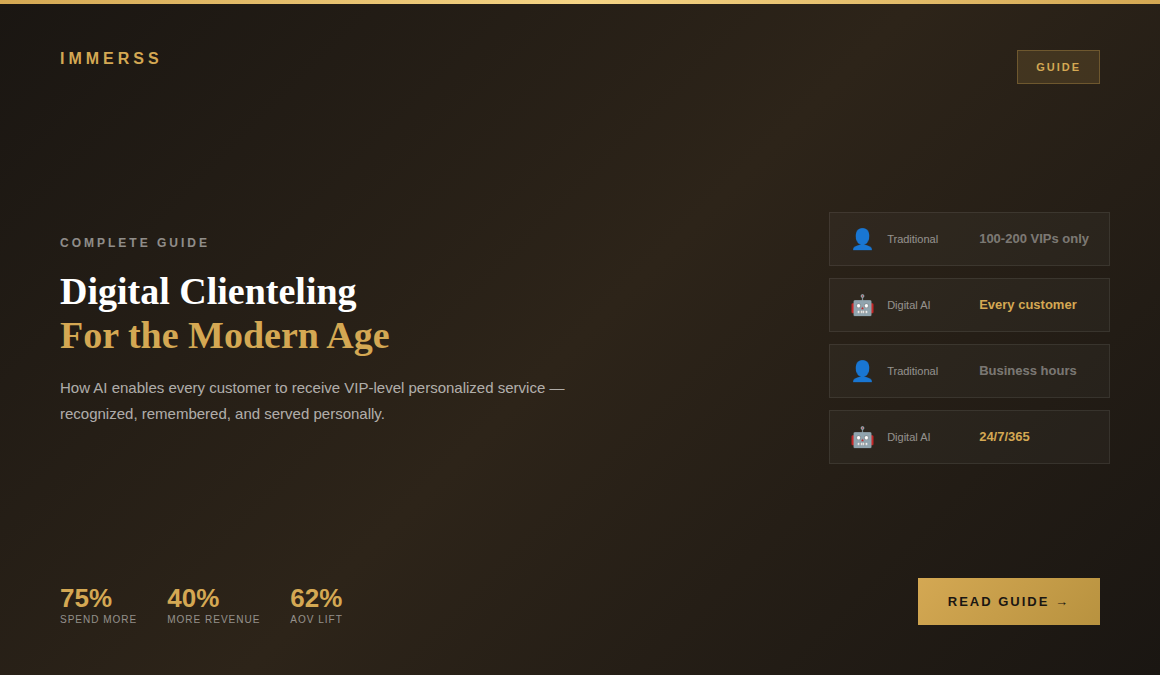
Digital Clienteling for the Modern Age: The Complete Guide
How AI enables every customer to receive VIP-level personalized service.
Executive Summary
Traditional clienteling — building personal relationships with customers to drive loyalty and lifetime value — has been the hallmark of luxury retail. But traditional approaches don’t scale: personal service was limited to VIP customers while everyone else received generic experiences. This guide explores how AI-powered digital clienteling extends personalized service to every customer, across every channel, around the clock.
Key insight: Companies that grow faster drive 40% more revenue from personalization than slower-growing counterparts. With AI, brands can deliver luxury-level personalized service at e-commerce scale.
The Clienteling Tradition
Clienteling emerged from luxury retail’s recognition that personal relationships drive business results.
When a boutique associate greets customers by name, remembers their preferences, and makes recommendations based on genuine understanding — customers respond. They buy more, spend more per purchase, and return more frequently.
Research validates this: 75% of shoppers are likely to spend more after receiving high-quality service from store personnel, according to the BoF-McKinsey State of Fashion 2025 report.
The economics are compelling. Loyal customers who feel personally served become long-term assets, generating consistent revenue over years or decades.
The Scalability Challenge
Traditional clienteling has an inherent limitation: it doesn’t scale.
A skilled sales associate can maintain meaningful relationships with perhaps 100-200 customers. This requires frequent interaction, careful attention, and meticulous record-keeping. The associate remembers preferences because they’ve served these customers repeatedly over time.
This approach works for high-value VIP customers who generate substantial revenue individually. But it creates structural inequality in customer experience:
VIP tier: Personal service, remembered preferences, proactive outreach, exclusive access.
Everyone else: Generic experience, starting from zero each visit, no recognition, no personalization.
In an era where customers experience personalization from Netflix, Spotify, and Amazon, this two-tier approach creates competitive vulnerability. Customers expect to be recognized and served personally regardless of their spending level.
The Digital Clienteling Solution
AI-powered digital clienteling addresses the scalability challenge while preserving personalization quality.
Comprehensive customer profiles. Instead of relying on human memory and handwritten notes, AI maintains detailed profiles on every customer automatically. Purchase history, browsing behavior, stated preferences, communication history — all captured and accessible instantly.
Omnichannel presence. Instead of limiting personalization to in-store interactions, AI engages across every channel: website, email, chat, social media. Personalization follows customers wherever they interact with the brand.
24/7 availability. Instead of confining personal service to business hours, AI provides round-the-clock engagement. Customers browsing at 3 AM receive the same personalized attention as those visiting at 3 PM.
Unlimited scale. Instead of rationing personal service to a select few, AI delivers personalization to every visitor simultaneously. One customer or one million — each receives individualized attention.
Digital Clienteling in Practice
The transformation manifests across every customer touchpoint.
Website personalization. Instead of displaying the same homepage to everyone, AI customizes content based on individual history. A customer who previously purchased jewelry sees jewelry-focused content. A customer who browsed handbags sees handbag recommendations. The experience feels curated rather than generic.
Product recommendations. Instead of “bestsellers” and “new arrivals” — identical for everyone — AI suggests products based on individual preferences. “Based on your interest in minimalist design, you might appreciate our new collection” feels meaningfully different from “Here’s what’s popular.”
Communication personalization. Instead of mass marketing emails, AI crafts individualized outreach. Messages reference past purchases, acknowledge preferences, and make contextually relevant suggestions. Communication feels like continuation of a relationship, not interruption.
Real-time engagement. When customers engage via chat, AI has instant access to their complete history. No need to start from zero — the conversation continues where the relationship left off. Customers don’t need to re-explain their preferences or repeat their history.
Proactive service. AI anticipates needs before customers articulate them. A customer who purchased a watch two years ago receives a service reminder. A customer who bought a dress for a wedding is contacted about accessory suggestions. The brand demonstrates understanding and attention.
The Research Foundation
Data validates the business impact of personalized service.
Revenue impact. Companies that grow faster drive 40% more revenue from personalization than slower-growing counterparts, per McKinsey research. Personalization directly correlates with business growth.
Customer spending. AI-driven clienteling produces meaningfully higher customer spending and a strong uptick in engagement when implemented effectively. The combination of relevance and attention drives purchasing behavior.
AOV lift. Kering’s Luce clienteling app boosted average order values by 15-20% across their luxury brands by enabling more informed, personalized customer interactions.
Cost efficiency. Personalization can reduce acquisition costs by up to 50% and increase revenues by 5-15%, per McKinsey data. The economics favor investment in personalization technology.
ROI consistency. 89% of marketers report positive ROI from personalization initiatives. The reliability of returns exceeds most other marketing investments.
From VVICs to Everyone
Traditional luxury retail obsessed over VVICs — Very Very Important Clients. These ultra-high-net-worth individuals received white-glove service, personal shoppers, exclusive access, and dedicated attention.
The math made sense when a small percentage of customers generated outsized revenue.
But customer expectations have evolved. Today’s consumers — regardless of spending level — expect personalized experiences. They’ve been trained by digital-first companies that personalize everything.
Digital clienteling democratizes the VIP experience:
Recognition. Every customer is greeted with awareness of their history and preferences.
Relevance. Every recommendation reflects individual taste rather than general popularity.
Relationship continuity. Every interaction builds on previous ones rather than starting fresh.
Proactive attention. Every customer receives outreach that demonstrates understanding.
This doesn’t diminish the experience for top clients — they continue receiving exclusive benefits. But it elevates experience for everyone else, creating broader loyalty and expanding the pipeline of customers capable of becoming tomorrow’s VIPs.
The Human-AI Partnership
Effective digital clienteling isn’t AI replacing humans — it’s AI amplifying human capability.
In physical retail: AI-powered clienteling platforms give sales associates instant access to customer profiles. Before a customer speaks, the associate knows their purchase history, preferences, and any outstanding service issues. The associate can greet customers by name and reference their last visit.
This context would have taken years to accumulate through organic relationship-building. AI provides it immediately, enabling every associate to deliver veteran-level service from day one.
In digital retail: AI handles the scalable aspects of personalization — product recommendations, email customization, chat engagement — while flagging opportunities for human intervention. High-value opportunities, complex requests, or customers expressing frustration get escalated to human staff with full context.
The division optimizes both capabilities: AI handles volume and routine, humans handle judgment and empathy.
Implementation Framework
Building digital clienteling capability follows a structured progression.
Phase 1: Data Foundation Establish unified customer profiles aggregating data from all touchpoints — online, in-store, email, social. Comprehensive data enables meaningful personalization; fragmented data limits it.
Phase 2: Basic Personalization Implement product recommendations based on browsing and purchase history. Personalize email communications based on engagement patterns. Customize website experience for returning visitors.
Phase 3: AI-Powered Engagement Deploy AI Sales Agents that engage customers in real-time conversation. Enable proactive outreach based on behavioral signals. Implement predictive recommendations that anticipate needs.
Phase 4: Omnichannel Integration Ensure personalization follows customers across channels. Online behavior informs in-store experience and vice versa. Create unified experience regardless of touchpoint.
Phase 5: Continuous Optimization Review performance data to identify high-impact personalization approaches. Refine AI models based on conversion and engagement outcomes. Expand personalization to additional touchpoints and customer segments.
The Immerss Approach
Immerss AI Sales Agents provide digital clienteling capabilities purpose-built for e-commerce.
Personalized engagement. AI engages visitors based on browsing behavior, identifying interests and offering relevant assistance. The interaction feels personal because it reflects individual context.
Context-aware recommendations. Based on stated needs and browsing patterns, AI suggests products matching individual preferences. Not generic bestsellers — specific recommendations with reasoning.
Relationship continuity. AI maintains context across interactions. Returning visitors receive recognition of their history and preferences.
24/7 availability. Digital clienteling operates around the clock. Late-night browsers receive the same personalized attention as daytime visitors.
Seamless escalation. When situations warrant human attention, AI hands off smoothly with full context. Customers never need to repeat themselves.
Results
Digital clienteling impact shows clearly in Immerss client outcomes.
Lucchese achieved meaningfully higher AOV with AI-assisted shopping. Personalized engagement built purchase confidence and guided customers toward complete solutions.
Dramatically higher conversion among visitors who engage with Immerss AI compared to passive browsers. Personalization transforms browsing behavior into purchasing behavior.
Materially more leads captured during off-hours through 24/7 AI availability. Digital clienteling works when human staff doesn’t.
The Competitive Imperative
Customer expectations have permanently shifted toward personalization.
Brands delivering personalized experiences across touchpoints build lasting customer relationships. Brands serving generic experiences struggle to compete against those who don’t.
The Customer Experience Enhancement sector — which includes clienteling technologies — is growing at 15.2% CAGR according to Cascadia Capital’s 2025 Retail Technology Report. Investment reflects recognition that personalization has moved from differentiator to necessity.
Digital clienteling through AI makes luxury-level personalized service accessible at any scale. The technology exists. The economics work. The question is whether brands will lead the shift or react to competitors who do.