AI Sales Agent ROI: A CFO’s Complete Guide
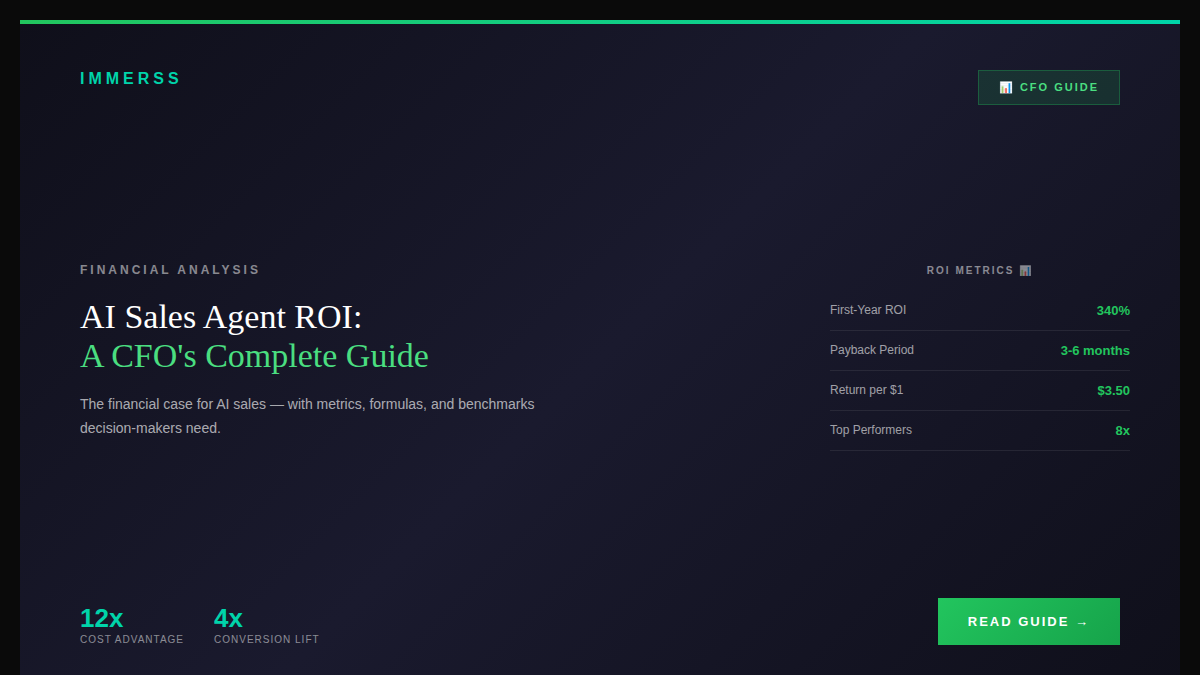
The financial case for AI sales technology — with the metrics, formulas, and benchmarks decision-makers need.
Executive Summary
This guide presents the financial case for AI Sales Agents in e-commerce. Drawing on industry research from Juniper Research, Gartner, McKinsey, and platform-specific data, it provides CFOs and decision-makers with the metrics needed to evaluate, model, and justify AI sales investments.
Key findings:
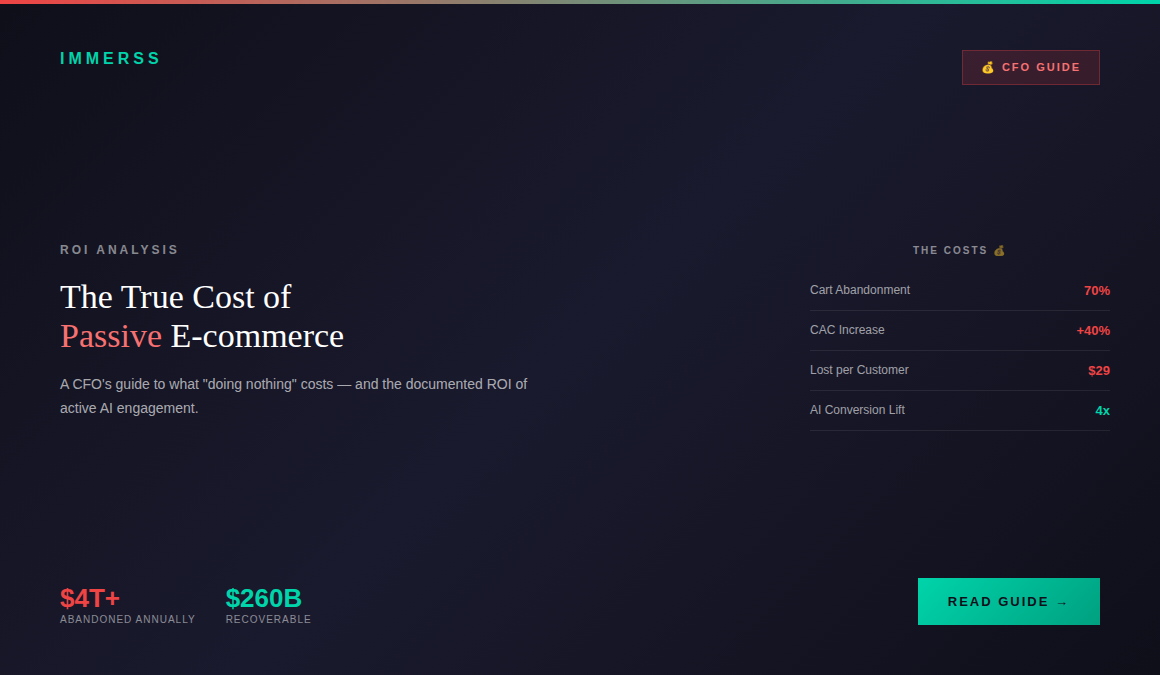
- 340% average first-year ROI with 3-6 month payback periods
- $3.50 return for every $1 invested (average); top performers achieve 8x
- 12x cost advantage per interaction ($0.50 vs $6.00)
- AI-engaged visitors convert at a dramatically higher rate
- 15-35% revenue increases from improved conversion and upselling
- 30-40% reduction in customer service costs
Part 1: The Cost Economics
Per-Interaction Cost Comparison
The fundamental cost advantage of AI is straightforward and well-documented:
| Interaction Type | Average Cost | Source |
|---|---|---|
| Human agent | $6.00 | Industry average |
| AI chatbot | $0.50 | Industry average |
| Cost ratio | 12x | — |
This 12x cost difference is the foundation of AI ROI calculations. Every interaction shifted from human to AI generates immediate savings.
Scaling the Savings
The savings compound at scale:
Small volume (1,000 interactions/month):
- Human cost: $6,000
- AI cost: $500
- Monthly savings: $5,500
- Annual savings: $66,000
Medium volume (10,000 interactions/month):
- Human cost: $60,000
- AI cost: $5,000
- Monthly savings: $55,000
- Annual savings: $660,000
High volume (100,000 interactions/month):
- Human cost: $600,000
- AI cost: $50,000
- Monthly savings: $550,000
- Annual savings: $6,600,000
Operational Efficiency Gains
Beyond per-interaction savings, AI delivers operational efficiency:
Response time: First response time reduced by 37% Resolution speed: Ticket resolution improved by 52% Availability: 24/7 coverage without overtime or shift premiums Scalability: Handle traffic spikes without staffing changes
Aggregate projection: Gartner projects $80 billion in contact center labor cost savings by 2026 from AI adoption.
The 30-40% Benchmark
Across research, the consistent finding is that AI implementation delivers 30-40% reduction in customer service costs. This includes:
- Direct labor cost reduction
- Training cost elimination for routine interactions
- Quality consistency (no bad days, no burnout)
- Reduced management overhead
Part 2: The Revenue Economics
Cost savings are often the easier ROI component to model. But for AI Sales Agents (as opposed to support bots), the larger opportunity is revenue generation.
Conversion Impact
The most significant data point:
Conversion rate without AI: your baseline (e.g. ~3%) Conversion rate with AI engagement: materially higher Improvement: substantial
This kind of improvement is reported across multiple studies. The mechanism is straightforward: AI provides the guidance, answers, and confidence that converts browsers into buyers.
Additional conversion metrics:
- 47% faster purchase decisions when AI-assisted
- 23% conversion rate improvement from AI personalization
- 67% sales increase from retail chatbots (aggregate)
Cart Abandonment Recovery
Cart abandonment represents massive revenue loss. AI changes the recovery equation:
| Recovery Method | Conversion Rate |
|---|---|
| Email follow-up | 10.7% |
| AI intervention (real-time) | 15-35% |
| Improvement | 2-3x |
E-commerce stores using AI for cart abandonment see 7-25% revenue boosts.
At 70% baseline abandonment rate and $4+ trillion annual abandoned cart value globally, even small recovery improvements represent significant revenue.
AOV Improvement
AI Sales Agents don’t just convert more visitors — they increase order values:
Returning customers with AI: +25% spend Upselling via AI: Occurs in 20% of interactions AI personalization revenue lift: Up to 40%
The Revenue Math
For a retailer with:
- $300,000 monthly revenue
- 100,000 visitors
- 2.5% conversion rate
- $120 AOV
Conservative AI impact:
- 30% of visitors engage with AI = 30,000 conversations
- AI-engaged conversion: 10% (vs 2.5% baseline)
- Net new conversions: ~1,500/month
- At $140 AOV (higher with consultation): $210,000 additional gross revenue
- At 30% margin: $63,000 additional monthly gross profit
Part 3: Comprehensive ROI Modeling
The ROI Formula
ROI (%) = ((Savings + Additional Revenue – Total Costs) / Total Costs) × 100Where:
- Savings = Cost reduction from automation
- Additional Revenue = Net new sales + AOV improvement
- Total Costs = Platform fees + implementation + ongoing management
Model: Mid-Market E-commerce
Business profile:
- 100,000 monthly visitors
- 2.5% baseline conversion
- $120 AOV
- $300,000 monthly revenue
- 5,000 customer interactions/month
- Current service cost: $30,000/month
AI implementation:
Cost component:
| Line Item | Calculation | Monthly |
|---|---|---|
| Previous service cost | 5,000 × $6.00 | $30,000 |
| AI handling (70%) | 3,500 × $0.50 | $1,750 |
| Human handling (30%) | 1,500 × $6.00 | $9,000 |
| New total service cost | — | $10,750 |
| Monthly savings | — | $19,250 |
Revenue component:
| Line Item | Calculation | Monthly |
|---|---|---|
| AI conversations | 100K × 30% | 30,000 |
| AI conversion rate | 10% | 3,000 conversions |
| Net incremental (50% factor) | — | 1,500 orders |
| Revenue at $140 AOV | — | $210,000 |
| Gross profit at 30% | — | $63,000 |
Investment:
| Line Item | Monthly |
|---|---|
| AI platform | $3,500 |
| Implementation (amortized) | $1,000 |
| Management overhead | $500 |
| Total investment | $5,000 |
ROI calculation:
ROI = (($19,250 + $63,000 - $5,000) / $5,000) × 100
ROI = ($77,250 / $5,000) × 100
ROI = 1,545%
Payback period: < 1 month
Model: Enterprise Retailer
Business profile:
- 1,000,000 monthly visitors
- 2% baseline conversion
- $200 AOV
- $4,000,000 monthly revenue
- 50,000 customer interactions/month
- Current service cost: $300,000/month
Conservative AI impact:
Savings: $190,000/month (70% automation, same cost structure) Additional profit: $600,000/month (1.5% conversion lift on engaged traffic) Platform cost: $25,000/month (enterprise tier)
Net monthly impact: $765,000 Annual impact: $9,180,000 ROI: 3,060%
Part 4: Timeline to Value
Industry Benchmarks
Initial benefits: 60-90 days Positive ROI: 8-14 months (comprehensive implementations) Payback period: 3-6 months (focused deployments)
The Phased Implementation Model
Research shows that phased implementations outperform big-bang deployments:
Phase 1 (Weeks 1-4): Foundation
- Deploy AI for top 20 FAQ questions
- Handle 40-60% of incoming volume
- Immediate cost savings measurable
- Low implementation risk
Phase 2 (Months 2-3): Sales Activation
- Add product recommendation capabilities
- Enable cart abandonment intervention
- Deploy guided selling for complex products
- Measure conversion impact
Phase 3 (Months 4-6): Optimization
- A/B test messaging and approaches
- Add channels (SMS, WhatsApp, social)
- Integrate with CRM for personalization
- Expand to additional use cases
Why Phased Beats Big-Bang
- Each phase proves ROI before next investment
- Allows learning and optimization
- Reduces implementation risk
- Builds internal capabilities progressively
Part 5: Risk Assessment
Implementation Challenges
Data security concerns: 53% of managers cite this Expertise gap: 44% of executives report lack of in-house skills Integration complexity: 3-6 months for platform integration (vs 12+ months for custom)
Mitigation Strategies
Security: Use enterprise-grade platforms with SOC 2, GDPR compliance Expertise: Start with managed services, build internal capabilities over time Integration: Choose platforms with pre-built connectors for your stack
Customer Acceptance Risk
The good news: customer acceptance is high and growing.
- 73% of consumers open to AI-powered chatbots
- 92% customer satisfaction rate with well-implemented AI
- 74% of U.S. shoppers say AI improved their shopping experience
- 91% prefer brands offering personalized AI-driven offers
Failure Mode Analysis
Where AI deployments underperform:
| Failure Mode | Cause | Prevention |
|---|---|---|
| Low accuracy | Poor training data | Invest in knowledge base quality |
| Customer frustration | No human escalation | Design seamless handoff flows |
| Missed sales | Support-only focus | Choose sales-first platforms |
| Low engagement | Passive deployment | Enable proactive engagement |
Part 6: Competitive Context
Market Adoption
The competitive landscape is shifting rapidly:
- 97% of retailers plan to increase AI spending
- 87% report positive revenue impact
- 94% see operating cost reduction
- 67% of Fortune 500 already use AI chatbots
- 64% of small businesses plan to adopt by 2026
First-Mover vs. Fast-Follower
First-mover advantages:
- Customer acquisition while competitors lack capability
- Learning curve benefits
- Brand differentiation
Fast-follower risks:
- Catching up to established competitors
- Higher expectations from customers
- Compressed implementation timelines
Cost of Inaction
The cost of NOT implementing AI is harder to measure but includes:
Missed revenue:
- Lost leads from slow response (30+ minutes = lost opportunity)
- Off-hours traffic with no engagement (30-40% of total)
- Lower conversion without assistance
Higher cost structure:
- Full human staffing while competitors automate
- Training and turnover costs
- Scaling challenges during peaks
Competitive disadvantage:
- Customer experience gap
- Price pressure from lower-cost competitors
- Market share erosion
Part 7: Vendor Evaluation Framework
Financial Criteria
| Factor | What to Evaluate |
|---|---|
| Total Cost of Ownership | Platform + implementation + ongoing |
| Pricing Model | Per-interaction, per-conversation, or flat rate |
| ROI Guarantees | Pilot terms, performance commitments |
| Hidden Costs | API calls, integrations, overages |
Technical Criteria
| Factor | Benchmark |
|---|---|
| Accuracy rate | 95-98% with RAG technology |
| Integration options | Pre-built connectors for your stack |
| Human escalation | Seamless handoff workflows |
| Analytics | Real-time conversion attribution |
Strategic Criteria
| Factor | Question |
|---|---|
| Sales vs. Support | Does the AI sell or just answer questions? |
| Proactive engagement | Can it initiate conversations based on behavior? |
| Product knowledge | How deep is catalog understanding? |
| Brand voice | How customizable is the personality? |
Part 8: The Immerss Approach
Immerss AI Sales Agents are built for revenue generation, not ticket deflection.
Financial Impact
Our customers see:
- Engaged visitors convert at a dramatically higher rate
- Meaningfully higher average order value (Lucchese case study)
- 24/7 coverage without staffing costs
- Measurable ROI from day one
Differentiation
Sales-first architecture: Built to guide decisions and close sales, not deflect to FAQ Luxury expertise: Trained for high-consideration, high-value purchases Human handoff: Seamless escalation to human experts when needed Integration: Works with your existing Shopify, WooCommerce, or custom stack
ROI Timeline
Week 1: Platform deployed, basic conversations live Month 1: Measurable engagement and conversion data Month 3: Full optimization, proactive engagement enabled Month 6: Comprehensive ROI proven, expansion opportunities identified
Conclusion: The Financial Case
The financial case for AI Sales Agents is clear:
Cost side:
- 12x cost advantage per interaction
- 30-40% service cost reduction
- $80B projected industry savings by 2026
Revenue side:
- Engaged visitors convert at a dramatically higher rate
- 15-35% revenue increases
- 2-3x cart recovery improvement
ROI:
- 340% average first-year return
- 3-6 month payback period
- $3.50 return per dollar invested (8x for top performers)
Risk:
- Manageable with phased implementation
- High customer acceptance (73%+)
- Proven technology with enterprise adoption (67% of Fortune 500)
The question for CFOs isn’t whether AI Sales Agents work. The data is unambiguous.
The question is how much value your specific business can capture — and whether you capture it before competitors do.