AI Sales for Jewelry: The Complete Guide to High-Touch, High-Value E-commerce
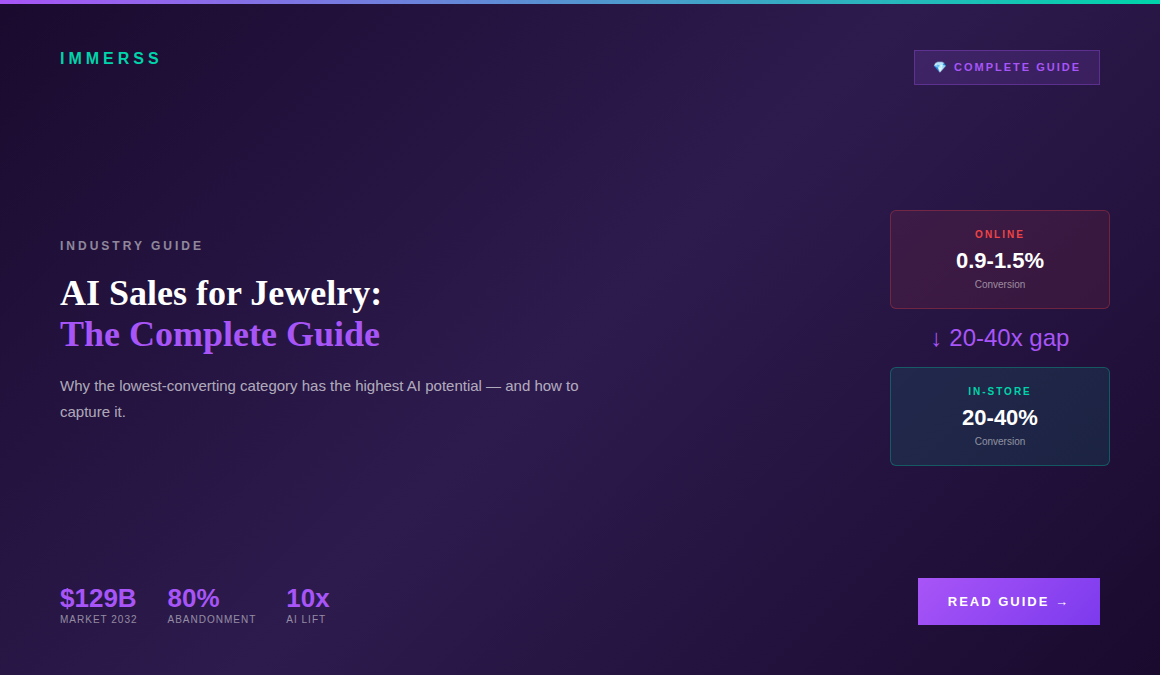
Why the lowest-converting category has the highest AI potential — and how to capture it.
Executive Summary
Jewelry is the lowest-converting category in e-commerce (0.9-1.5%) while commanding the highest average order values ($500-$10,000+). This paradox exists because jewelry purchases require consultation — expert guidance through emotional, high-stakes decisions — that standard e-commerce cannot provide. AI Sales Agents restore this consultation capability online, helping engaged visitors convert at a dramatically higher rate. This guide explores why jewelry uniquely benefits from AI and how retailers can implement it effectively.
Key insight: Jewelry’s conversion problem isn’t about products or marketing — it’s about the absence of consultation. AI Sales Agents solve this directly.
The Jewelry E-commerce Problem
The data paints a stark picture.
Jewelry conversion rates: 0.9-1.5% (the lowest of any e-commerce category) Food & beverage conversion: 6%+ (the highest) Jewelry cart abandonment: ~80% In-store jewelry conversion: 20-40%
The gap between online and offline isn’t a small optimization problem. It’s a 20-40x differential that represents billions in unrealized revenue.
The online jewelry market reached $46 billion in 2024 and is projected to hit $129 billion by 2032. As this channel grows, conversion rates remain stubbornly low — meaning more traffic, same problems, missed opportunity.
Why Jewelry Doesn’t Convert Online
Jewelry purchasing has unique characteristics that standard e-commerce fails to address.
Emotional Significance
Jewelry purchases mark life milestones — engagements, weddings, anniversaries, graduations, personal achievements. The emotional stakes are higher than almost any other product category.
Emotional purchases require confidence. Uncertainty kills conversion.
Static product pages create uncertainty. Customers see options but lack guidance on which is “right” for their specific moment.
Extended Decision Cycles
A $25 sauce is an impulse buy. A $3,000 ring is a considered purchase.
Jewelry customers research extensively, compare options, revisit multiple times before committing. This extended cycle creates multiple abandonment opportunities.
The decision cycle needs support at every stage. Product pages provide information at one stage only.
Need for Expert Guidance
Customers have questions product descriptions can’t answer:
- What’s the difference between VS1 and VS2 clarity in practical terms?
- Which metal will work best for my skin tone?
- Is this setting durable for everyday wear?
- What does this certification actually guarantee?
- How do I choose between these three similar pieces?
Without expert guidance, questions become doubts. Doubts become abandonment.
Tactile and Visual Uncertainty
How does it catch the light? How will it look on my hand? What does the weight feel like?
Photography helps but can’t fully replicate physical examination. This sensory gap creates purchasing hesitation unique to jewelry.
Trust and Authentication Concerns
Is it authentic? Is the price fair? Will quality match claims?
Online purchasing introduces trust barriers that don’t exist when handling a piece in-store with a knowledgeable associate.
The Consultation Solution
Walk into a quality jewelry store and observe the experience.
A knowledgeable associate greets you. They ask about the occasion, recipient, style preferences. They show options matching your criteria. They explain differences between cuts, settings, and metals. They let you try pieces, compare, and consider. They answer questions, address concerns, and build confidence.
This consultation experience drives 20-40% conversion — compared to online’s sub-2%.
The gap is consultation, not product.
How AI Restores Consultation Online
AI Sales Agents provide expert guidance at digital scale, restoring what online jewelry shopping lost.
Discovery Guidance
Without AI: Customer scrolls through 500+ products, overwhelmed by options, filters randomly, struggles to narrow down.
With AI:
“I’m looking for an engagement ring. She likes vintage styles but I don’t know much about diamonds.”
AI responds: “Vintage-inspired rings are a beautiful choice. Let me help you find the perfect one. What’s your budget range? And does she typically wear gold or silver jewelry?”
The conversation narrows to relevant options within minutes.
Education in Conversation
Without AI: Customer reads dense specifications, struggles to interpret what VS1 vs VS2 means in practice.
With AI:
“What’s the difference between these clarity grades?”
AI responds: “VS1 means inclusions aren’t visible to the naked eye — you’d need magnification to see them. VS2 might have very slight inclusions visible to careful inspection. For practical purposes, both look flawless when worn. VS2 typically costs 10-15% less, so many choose it to put budget toward size or cut quality instead.”
Complex information becomes accessible and actionable.
Guided Comparison
Without AI: Customer opens multiple browser tabs, loses track, can’t effectively compare.
With AI: AI presents side-by-side comparisons with relevant differences highlighted, guiding evaluation toward confident decision.
Objection Resolution
Without AI: Customer has concern about size uncertainty, return policy unclear, abandons rather than risk.
With AI: AI proactively addresses concerns: explains resize options, clarifies return window, confirms guarantee — resolving objections before they cause abandonment.
Confidence Building
Without AI: Customer feels uncertain, decides to “think about it,” never returns.
With AI: Throughout consultation, AI builds confidence through expertise, attention, and reassurance: “This is an excellent choice for what you described — the certification ensures quality, and our 30-day guarantee protects your purchase.”
The Data Behind AI for Jewelry
Research validates why jewelry benefits most from AI consultation.
Live shopping for jewelry converts at ~10% compared to standard e-commerce’s sub-1%. The difference is real-time interaction versus passive browsing. AI provides similar interactive engagement.
75% of high-net-worth individuals report comfort purchasing luxury jewelry online — when they receive adequate consultation. The barrier isn’t the channel; it’s the support.
Jewelry’s 80% cart abandonment isn’t final rejection. Shoppers add while dreaming, abandon over uncertainty. Consultation addresses uncertainty, recovering otherwise lost purchases.
Gen Z consumers are 2.5x more likely to purchase jewelry via interactive channels. The generational shift favors guided experience over passive browsing.
The Immerss Approach for Jewelry
Immerss AI Sales Agents are purpose-built for high-touch, high-value selling — making jewelry a natural fit.
Deep product expertise. AI learns your entire collection — every stone, setting, metal, customization option. It can discuss specifics that generic chatbots can’t address.
Brand voice customization. AI communicates in your brand’s tone and values. A heritage jeweler with 100-year legacy sounds different from a contemporary designer. The conversation matches your identity.
Consultation flow. AI guides the natural consultation arc: discovery → education → comparison → decision. Not FAQ deflection — actual selling.
24/7 availability. Customers research significant jewelry purchases at all hours — often late evening when contemplating milestone moments. AI is present for these high-intent moments.
Multi-visit context. Jewelry decisions span multiple sessions. AI remembers previous conversations, building relationship across visits.
Seamless purchase path. Consultation leads directly to confident purchase without friction or handoff confusion.
Results: Jewelry Performance
AI consultation impact on jewelry is dramatic given the low baseline.
Dramatically higher conversion among engaged visitors compared to passive browsers. For jewelry’s roughly 1% baseline, that represents a transformational shift.
Significant AOV lift through complete-solution selling. Consultation guides customers toward matching pieces, appropriate settings, and quality levels — increasing basket value.
Engagement rates of 20-30% versus typical chatbot engagement of 5-10%. Customers engage when AI can actually help with their specific situation.
Recovered abandonment through proactive outreach to hesitant shoppers, addressing concerns before they finalize abandonment decisions.
Implementation: Getting Started
Jewelry retailers can implement AI Sales quickly and see rapid results.
Phase 1: Foundation (Week 1-2)
- Product catalog integration
- Brand voice configuration
- Common question/objection mapping
- Basic consultation flows
Phase 2: Optimization (Week 3-4)
- Analyze conversation patterns
- Refine responses based on engagement
- Add product-specific guidance
- Implement proactive triggers
Phase 3: Scale (Month 2+)
- Expand to additional touchpoints
- Integrate with CRM/loyalty
- Add customization consultation
- Enable video consultation hybrid
The Opportunity Math
Consider a typical jewelry retailer’s transformation potential.
Current state:
- 50,000 monthly visitors
- 1% conversion = 500 orders
- $1,500 AOV
- Monthly revenue: $750,000
With AI Sales engagement:
- 50,000 monthly visitors
- 30% engage with AI = 15,000 conversations
- 10% of engaged convert = 1,500 orders
- $2,000 AOV (through consultation) = $3,000,000 monthly revenue
Revenue impact: $2.25M additional monthly revenue from same traffic
Even conservative assumptions show transformational impact because jewelry AOV amplifies every conversion improvement.
The Competitive Imperative
The online jewelry market is growing rapidly — from $46 billion in 2024 toward $129 billion by 2032.
Retailers who continue with passive product-grid experiences will see traffic grow but conversion stay flat. Those who implement consultation will capture disproportionate share of growing market.
The question isn’t whether AI consultation helps jewelry — the data is clear. The question is whether you’ll implement before competitors do.