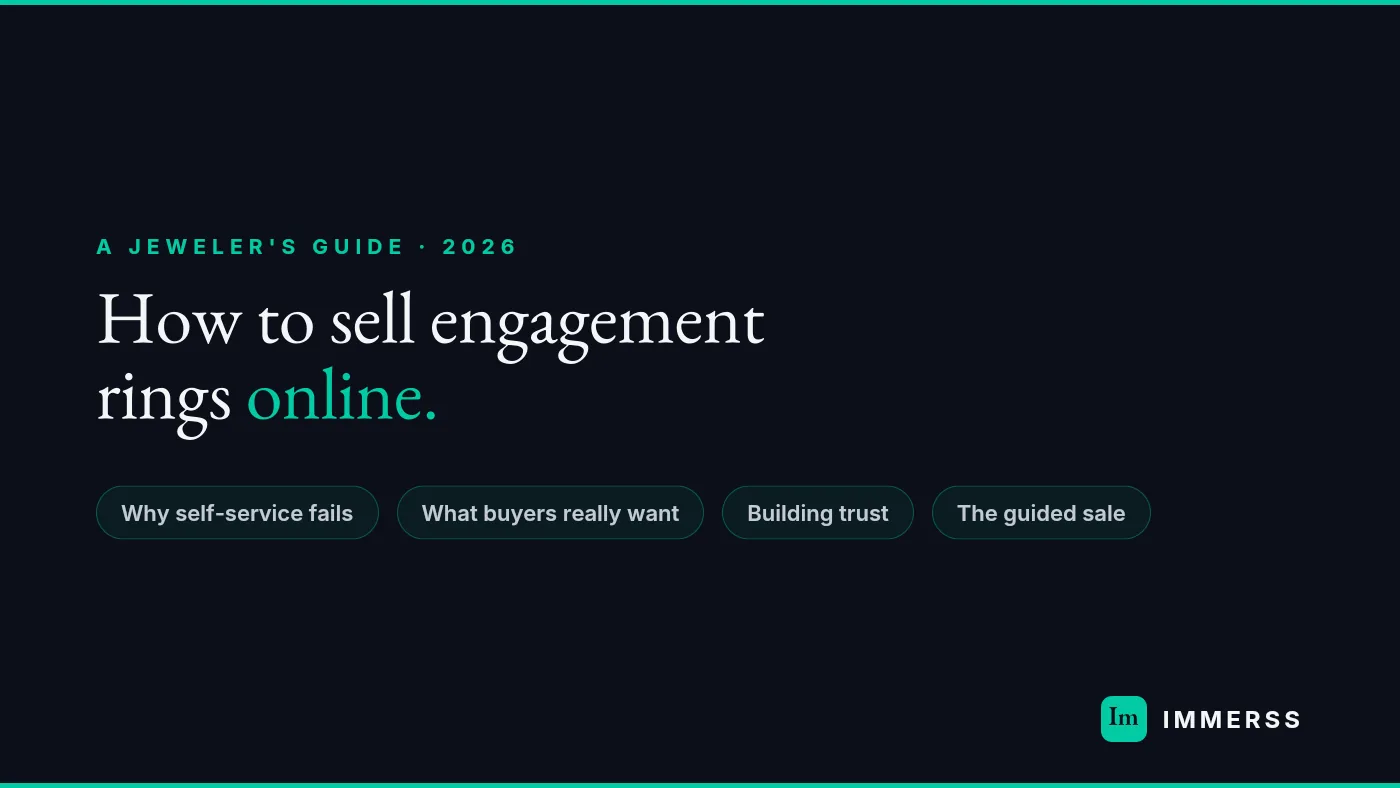
Selling engagement rings online in 2026 comes down to one thing most jewelers get wrong: the engagement ring is the most guidance-dependent purchase in retail, and a self-service product grid is the worst possible way to sell it. The typical buyer is an anxious novice spending more than they ever have on something they don’t understand, for the most important moment of their life. This guide explains why engagement rings resist self-service, what online buyers actually need, and how to sell them the way they’re really bought — through guidance.
The short version: stop selling engagement rings through filters, and start selling them through a guided, trusted conversation.
How do you sell engagement rings online in 2026?
You sell engagement rings online in 2026 by replacing self-service with guidance: meeting the anxious, first-time buyer with education, reassurance, and a real advisor instead of a product grid and a set of filters. The engagement ring is unlike any other ecommerce purchase — once-in-a-lifetime, emotionally overwhelming, technically unfamiliar, and high-stakes — so the standard ecommerce playbook (better photos, faster checkout, smarter filters) underperforms. The jewelers who convert online engagement ring traffic well do it by adding a guided layer: an AI sales agent that engages and qualifies the buyer, handing serious shoppers to a live one-to-one video consultation. The sections below break down why, and how.
Why are engagement rings hard to sell online?
Engagement rings are hard to sell online because they stack more sources of buyer difficulty into one purchase than almost anything else in retail. It’s a once-in-a-lifetime purchase, so the buyer has no experience to draw on. It’s high-stakes beyond money — it symbolizes a proposal, a relationship, a future — so the fear of getting it wrong is intense. It’s technically unfamiliar — the 4 Cs, settings, metals, certifications, lab-grown versus natural — a new vocabulary encountered at the worst possible moment. It often involves secrecy, so the buyer can’t consult the person whose opinion matters most. And it increasingly involves customization, multiplying the decisions. Together these make the engagement ring the most guidance-dependent purchase in ordinary retail — and a self-service grid serves it worst. It’s worth noting that almost every other expensive purchase lacks at least one of these difficulties: a car or laptop the buyer understands, furniture they buy repeatedly, a luxury handbag they can research calmly. The engagement ring is the rare purchase that is expensive and unfamiliar and emotionally overwhelming and often secret and technically complex and once-in-a-lifetime, all at once — which is exactly why the standard ecommerce playbook, tuned for simpler purchases, underperforms so badly on it.
What do online engagement ring buyers actually want?
Online engagement ring buyers want a guide, not a catalog: someone knowledgeable to teach them what matters, narrow the options, answer their real questions, and reassure them they’re making a good choice. Their real questions aren’t “show me 1.5-carat rings” — they’re “am I doing this right?”, “how do I not mess this up?”, and “can I trust you?” They want the 4 Cs explained in plain language, the overwhelming field narrowed to a few good options for their budget and their partner, and the confidence that a real person has their back on the most important purchase of their life. This is precisely the role the great in-store jeweler always played — and exactly what disappears in a self-service flow.
Why does self-service fail for engagement rings?
Self-service fails for engagement rings because it asks an anxious novice to make expert decisions alone. A product grid with carat, cut, color, and clarity filters requires the buyer to specify the very things they came in not knowing — it offers more choices to someone already overwhelmed, and answers none of their real (emotional, trust-based) questions. For a low-consideration impulse buy, self-service is efficient; for the highest-anxiety purchase of someone’s life, it amplifies the anxiety instead of resolving it. The predictable result: the most anxious, highest-intent buyers bounce off the grid and go elsewhere for the guidance it couldn’t provide. (See why high-ticket carts get abandoned.)
Where do engagement ring buyers go when a site fails them?
When a self-service site fails them, engagement ring buyers go looking for the guidance they didn’t get — to Reddit threads and forums, review and comparison blogs, a competitor who answered their questions, or the store down the street where someone will explain things. The anxiety one jeweler’s website amplified becomes another’s opportunity to soothe. In a purchase this guidance-dependent, the sale typically goes not to the best inventory or lowest price, but to whoever finally calms the buyer down, teaches them what they need to know, and earns their trust. The quiet leak in most online engagement ring businesses isn’t traffic — it’s high-intent buyers arriving, finding no guide, and leaving to be guided elsewhere.
How do you build trust selling engagement rings online?
You build trust selling engagement rings online by adding a human who educates and reassures, and by making the purchase transparent. Concretely: explain the 4 Cs and tradeoffs in plain language rather than assuming expertise; show certifications, grading, and sourcing openly; let buyers see the ring properly (4K and macro) so it reads as it would across the counter; and give them access to a real advisor who answers questions without pressure. Trust on a five-figure, once-in-a-lifetime purchase isn’t built by a trust badge in the footer — it’s built by a knowledgeable person who clearly has the buyer’s interest at heart, delivered through a real conversation. The fastest way to lose trust, conversely, is to push price or upsell a frightened novice; the fastest way to earn it is to tell them honestly which tradeoffs are worth making and which aren’t, even when that means a smaller sale today. The buyer who feels guided rather than sold returns for the wedding bands, the anniversaries, and the gifts for every occasion after.
How does live video consultation help sell engagement rings?
Live video consultation helps sell engagement rings by restoring the in-store guidance the purchase depends on. Instead of a grid, the buyer is met by a real advisor on a one-to-one video call who teaches them what matters, listens to what they’re trying to do, narrows the options to a few good ones, shows the rings in 4K, answers their real questions, and walks them to a confident choice. The engagement ring is, in fact, the single best-fitting use case for consultation commerce in all of retail — highest emotion, highest stakes, deepest novice anxiety, most technical complexity — every dial turned to maximum on the axes where guidance wins and self-service fails. Notably, the large online retailers who sell rings at scale already prove this: they win by adding education, virtual appointments, and expert consultations — guidance bolted onto the funnel — not by perfecting filters. The independent jeweler’s advantage is delivering that guidance more personally, through the trusted relationship a frightened first-time buyer most wants. (See how live video consultation closes online diamond sales, and how the AI sales agent and live consultation work together.)
Want to see what that consultation looks like on your own catalog? See it on your store.
How to guide an engagement ring customer through the purchase
A simple framework for the guided online engagement ring sale:
- Engage early. An AI sales agent meets the buyer, answers first questions, and senses high intent — catching the anxious shopper before they bounce.
- Educate, don’t quiz. Explain the 4 Cs and tradeoffs in plain language; never ask the novice to specify expert parameters cold.
- Hand to a human. Route the serious, high-intent buyer to a live one-to-one video consultation with an advisor.
- Narrow and show. The advisor narrows the overwhelming field to a few good options for the budget and partner, and shows them properly in 4K.
- Reassure and close. Answer the real questions, confirm the choice with genuine expertise, and walk the buyer, confident, to purchase at full price.
- Begin the relationship. Capture the customer for the wedding bands, anniversaries, and lifetime of milestones the ring begins.
Worked example: model the cost of a self-service engagement-ring funnel
Here’s a calculation you can run with your own numbers — no outside figures required. Gather four inputs from your own analytics:
- Monthly high-intent engagement-ring sessions — shoppers who browse rings with purpose, not bounce traffic.
- Your average engagement-ring order value.
- Your current online (self-service) conversion rate on that traffic.
- Your in-store consultation conversion rate — the rate a real advisor closes at across the counter.
Now compare two scenarios on the same traffic: converting it at your self-service rate, versus routing a share of those high-intent shoppers into a guided consultation and converting that share closer to your in-store rate. The revenue difference between the two is the size of the guidance gap on your store — the buyers arriving with intent that a product grid leaves on the table. For most jewelers the gap between the online self-service rate and the in-store consultation rate is wide, which is exactly why guidance, not a better filter, is the lever. Plug in your own numbers; the shape of the answer rarely changes.
Is your store ready to sell engagement rings online this way?
Run this filter:
- Shopify Plus, meaningful engagement-ring traffic, AOV $2,000+ (decisive at $5,000+).
- Your online engagement-ring conversion badly trails your in-store rate.
- You see high-intent traffic that browses and bounces without buying or booking.
- You have the product expertise to guide — you just haven’t brought it online.
If two or more are true, a guided model is your opportunity. (See where you stand on the jewelry ecommerce benchmarks.)
What to measure
Track the things a guided engagement-ring funnel should move:
- Consultation booking rate from engagement-ring traffic.
- Consultation conversion and full-price AOV on guided sales.
- Online-vs-in-store conversion gap on engagement rings specifically.
- Repeat/return rate — wedding bands and anniversaries from engagement-ring customers (the lifetime value the ring begins).
The 60-day pilot, on us
The best way to see what guidance does for your engagement-ring sales is to run it on your own traffic and measure it. That’s what the pilot is for.
We run a structured 60-day pilot, on us — an AI sales agent engaging and qualifying high-intent engagement-ring shoppers, live one-to-one video consultation as the selling mechanism, and measurement around consultation conversion, full-price AOV, and the in-store-vs-online gap. The model is deliberately human (a real advisor on the call, not a script), personal (one-to-one, tuned to this buyer, this partner, and this budget), and measurable (every consultation, conversion, and full-price sale tracked). You change no platform and risk no margin to see what guiding the most anxious buyers in retail does for your store.
See the pilot for merchants: landing.immerss.live Agency partner program: partners.immerss.live
Immerss is a luxury live commerce platform — an AI Sales Agent, 1:1 Live Co-Shopping and outbound clienteling, and video commerce for fine jewelry, watches, and high-AOV retail, built on Shopify Plus.