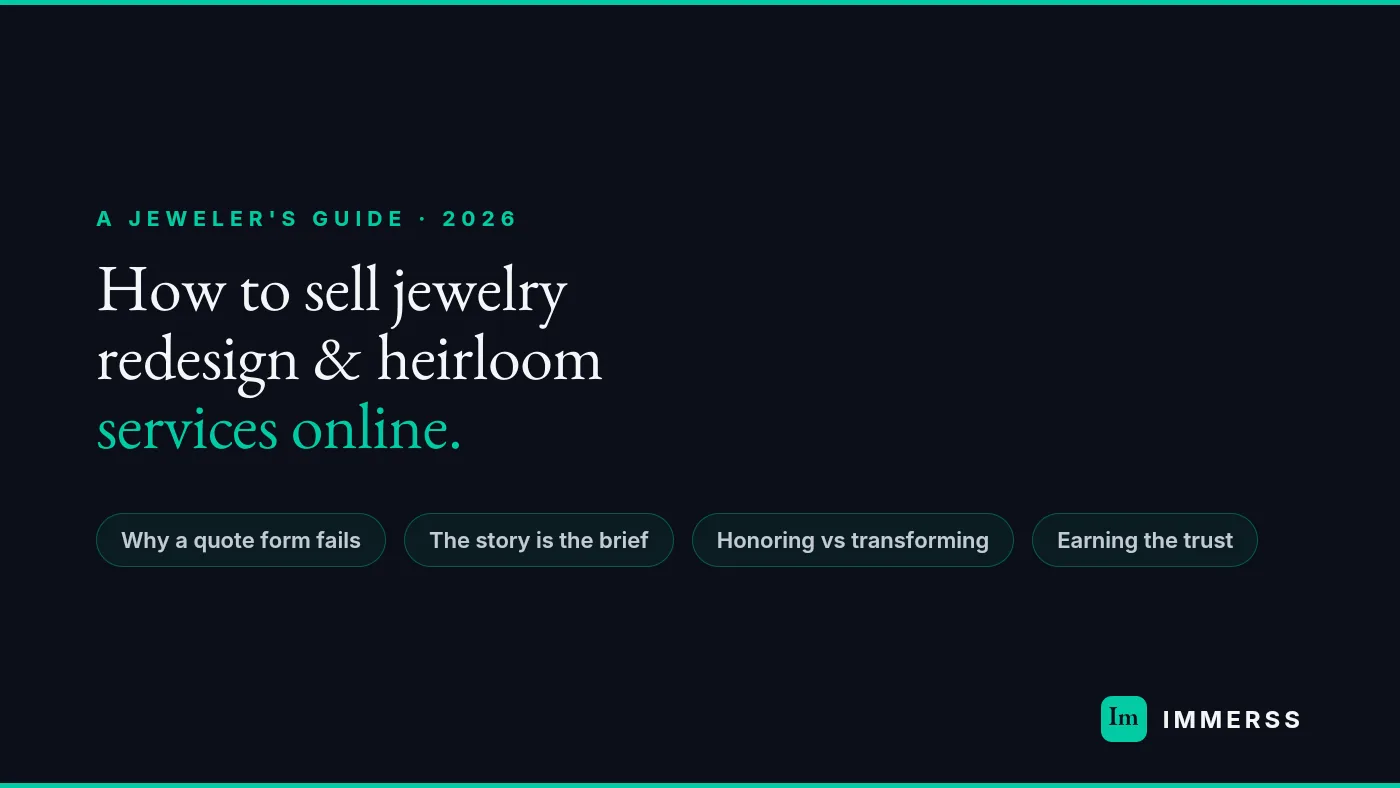
Selling jewelry redesign online in 2026 comes down to a truth most jewelers miss: redesign isn’t a transaction, it’s an act of trust. The customer isn’t buying a new piece — they’re entrusting you with something irreplaceable, an heirloom loaded with the memory of a person they often loved and lost, and asking you to take it apart and remake it without destroying what it means. You cannot earn that trust through a “Request a Quote” form. This guide explains why redesign resists self-service, why the story (not specs) is the brief, and how live consultation earns the trust to sell one of the highest-margin, most loyalty-generating services in jewelry.
The short version: stop selling redesign with a form, and start earning it with a conversation.
How do you sell jewelry redesign and heirloom services online in 2026?
You sell jewelry redesign online in 2026 by replacing the quote form with a consultation that earns trust. Redesign is the most trust-dependent service in jewelry: the customer is handing over an irreplaceable, emotionally loaded object to be transformed, and the entire sale turns on whether they can trust you with it. A form can’t answer that; a live one-to-one conversation can — by hearing the story behind the piece, understanding what must be preserved, showing how the transformation could work, and reassuring the customer about safety and process. The jewelers who sell redesign well online lead with a conversation: an AI sales agent that engages the inquiry warmly and a live consultation where trust is built and the redesign is designed.
Why is jewelry redesign so hard to sell online?
Jewelry redesign is hard to sell online because, unlike any other jewelry sale, the customer is entrusting you with something irreplaceable rather than acquiring something new. In a normal purchase, the risk is disappointment and the downside is money. In redesign, the customer hands over an heirloom whose material worth is the least of it — an object holding the memory of a person, often one they’ve lost — and consents to have it taken apart and remade. The downside isn’t a returnable purchase; it’s the permanent loss or violation of something that can never be recovered. That raises the trust required far above any other jewelry service, and standard self-service ecommerce, built to move products from inventory to buyer, has no mechanism for earning that kind of trust.
Why doesn’t a “Request a Quote” form work for redesign?
A quote form doesn’t work for redesign because it asks for trust it has done nothing to earn, at the exact moment trust is the only thing that matters. The form requests a photo and a description and expects the customer to commit to mailing the single most precious object they own to a company they’ve never spoken to. You can’t look at an upload field and feel that the person on the other end will cherish your grandmother’s ring the way you do. So most people, faced with a form and an irreplaceable heirloom, do the sensible thing — they close the tab and leave the ring in the drawer, unworn, for another decade. The service doesn’t lose them on price or design; it loses them by asking the impossible through the wrong medium. (See why high-trust jewelry purchases need a guided, human conversation, not a form.)
Why is the story the design brief in redesign?
In redesign the story is the brief because the meaning lives in the story, not in specifications. To remake an heirloom well you have to understand what a form never asks: who it belonged to, what it meant, which parts carry the memory and which are just old-fashioned metal, what the customer is trying to hold onto and what they’d gladly let go. Is it the stones that matter, because they were grandmother’s, and everything else can change? Or the silhouette they remember on her hand, which must survive even if the stones are reset? You can’t know without hearing the story, and the story determines what to keep sacred and what to transform. A “describe what you want” box misses the point, because the customer often doesn’t fully know what they want — they know what they feel, and drawing the design out of the feeling is the jeweler’s real work. That work is a conversation.
How do you balance honoring the heirloom and transforming it?
You balance honoring and transforming by navigating, in conversation, the central tension of redesign: the customer wants to keep the meaning and change the form. They want to wear it, which as-is they don’t or can’t, so something must change — style, setting, size, datedness. But what made it precious has to survive intact. Change too little and it’s a repair, not a redesign, and they still won’t wear it; change too much and you’ve made a new piece that lost the soul of the old one — the exact betrayal they feared. The right redesign lives in the narrow space between “unchanged and unworn” and “transformed and hollow.” Finding it for a specific person and piece requires asking, gently, “what can we change, and what must we never touch?” — and listening to an answer that’s often emotional and half-formed. Only a conversation can find that line, and it’s different for every person and piece.
How is redesign different from a new custom or bespoke piece?
Redesign differs from bespoke in one decisive way: bespoke creates something from nothing, while redesign transforms something that already exists and already carries irreplaceable meaning. Both are co-design services sold through conversation, but redesign adds a dimension bespoke doesn’t have — the customer isn’t just collaborating on a vision, they’re entrusting a physical, irreplaceable object loaded with the memory of a person, and consenting to have it altered. That raises the emotional stakes and the trust required even higher than bespoke, and it changes the design work: in bespoke the vision is open, while in redesign the vision is constrained by what must be preserved from the original. The conversation has to do everything a bespoke consultation does, plus honor an existing meaning and earn the trust to handle the irreplaceable. (See how to sell custom and bespoke jewelry online.)
How does live consultation sell redesign and heirloom services?
Live consultation sells redesign because everything the service requires is exactly what a conversation provides and a form withholds. On a one-to-one video call, the jeweler asks about the piece and the person it came from, and listens — hearing the story that is the design brief. They show, gently, how the transformation could work while preserving what matters. They address the fears the customer hasn’t voiced: how the piece is protected, insured, and handled; that nothing irreversible happens without approval; that the memory will be respected at every step. By the end, the customer trusts this jeweler with the irreplaceable, because they’ve experienced directly that the jeweler understands what they’re really handing over. An AI sales agent can meet the inquiry warmly and offer the consultation without forcing a nervous customer through a form. For redesign, the consultation isn’t the path to the sale — it’s the only path there is. See it on your store.
How to sell a redesign online: a step-by-step approach
A practical framework for the trust-first redesign sale:
- Meet the inquiry warmly. An AI sales agent engages the redesign inquiry with care and offers a conversation — never a cold form as the first step.
- Invite a no-commitment consultation. Move the hesitant customer from “request a quote” to “let’s talk it through first,” with no obligation to proceed.
- Hear the story. The jeweler asks about the piece and the person it came from, and listens — the story is the brief.
- Show the transformation. Present, gently, how the redesign could honor what matters while making the piece wearable again.
- Earn the trust. Address safety, insurance, process, and approval steps directly, so the customer feels confident handing over the irreplaceable.
- Carry the relationship for life. A redesign done with care creates the deepest loyalty in jewelry — nurture it into future work and referrals through ongoing clienteling.
Why the redesign customer is won by a person, not a better form
It’s tempting to think the fix is a smarter intake form — more fields, better photo upload, an instant estimate. It isn’t. The redesign customer was never going to be won by a better form; they were going to be won by being able to trust a person with something irreplaceable. Every improvement you make to the form is effort spent on the wrong axis. The customer’s hesitation isn’t friction in a workflow — it’s the entirely rational reluctance to mail a lost mother’s ring to strangers. You don’t dissolve that with a cleaner UI; you dissolve it with a face, a voice, and a conversation that proves the piece is in careful hands. That’s why the jewelers who win redesign online move their effort off the form and onto the consultation.
Is your store ready to sell redesign this way?
Run this filter:
- Shopify Plus, real redesign/heirloom demand, average project value $1,000+ (decisive at $3,000+).
- Your redesign inquiries stall in a quote form and rarely convert.
- Your in-person redesign consultations close at a far higher rate than your online inquiries.
- You have the craft and sensitivity to handle heirlooms — you just haven’t brought the trust-building conversation online.
If two or more are true, a consultation-led redesign model is your opportunity. (See where you stand on the benchmarks.)
What to measure
Track the things a consultation-led redesign funnel should move — every one of them measurable from day one:
- Inquiry-to-consultation rate from redesign traffic.
- Consultation-to-project conversion and average project value.
- Quote-form abandonment vs. consultation completion.
- Repeat and referral rate from redesign clients (the deepest loyalty in jewelry).
The 60-day pilot, on us
The best way to see what a conversation does for your redesign sales is to run it on your own inquiries and measure it. That’s what the pilot is for.
We run a structured 60-day pilot, on us — an AI sales agent engaging redesign and heirloom inquiries warmly, live one-to-one video consultation as the trust-building and design mechanism, and measurement around consultation conversion, average project value, and inquiry-to-project rate. You change no platform and risk no margin to see what leading redesign with a conversation does for your store. It’s the whole Immerss thesis in miniature: an experience that is human, personal, and measurable.
FAQ: selling jewelry redesign & heirloom services online
Can you sell jewelry redesign online? Yes — but not through a quote form. Redesign is the most trust-dependent service in jewelry, so it’s sold through a conversation, typically a live consultation, where the jeweler hears the story, shows the transformation, and earns the trust to be handed an irreplaceable piece. Leading with a form loses most inquiries.
Why do redesign inquiries fail to convert online? Usually because a “Request a Quote” form asks the customer to mail an irreplaceable heirloom to a company they’ve never spoken to, before any trust is built. Faced with that, most people leave the piece in the drawer. A consultation converts them because it earns the trust the form can’t.
How do you redesign an heirloom without losing its meaning? By understanding, in conversation, which parts carry the memory and which can change — then transforming the form while preserving what matters (often the original stones, or a remembered silhouette). The balance is different for every piece and can only be found by hearing the story.
Is it safe to send in a family heirloom for redesign? Reputable jewelers protect and insure the piece, document it, and make no irreversible changes without the customer’s approval. A good consultation walks the customer through exactly how their heirloom is handled at each step — which is a large part of how trust is earned.
Why are redesign clients so loyal? Because a redesign done with care isn’t a purchase — it’s an act of restoration. You gave someone back a way to wear and keep a lost loved one close. Clients don’t forget that, and they refer others, making redesign one of the most loyalty-generating services a jeweler offers.
See the pilot for merchants: landing.immerss.live Agency partner program: partners.immerss.live
Immerss is a luxury live commerce platform — AI Sales Agent, Clienteling (1:1 live co-shopping and outbound), and Video Commerce for fine jewelry, watches, and high-AOV retail, built on Shopify Plus.