The engagement ring vertical is the highest-AOV, highest-stakes purchase in fine jewelry. It is also the vertical where the gap between in-store close rates and online conversion is widest in the category. For operators with credible bridal inventory, this gap represents one of the largest underconverted opportunities in the digital surface — and it is a gap that the standard ecommerce playbook cannot close.
This piece is the tactical playbook for running an engagement ring pilot specifically — what the buyer needs that conventional ecommerce does not provide, what the operational deployment looks like, the timeline considerations for capturing the November-February proposal season, and how the structured 60-day pilot maps to bridal traffic specifically.
Why The Bridal Conversion Gap Exists
The engagement ring buyer behaves differently from any other ecommerce shopper. The session pattern is consistent across operators:
- Significantly longer dwell times on individual product pages
- Multiple returning visits over weeks or months
- Heavy use of configurators that rarely complete to checkout
- Comparison behavior across many more SKUs than typical luxury categories
- Evening-research timing patterns suggesting deliberation outside work hours
- Almost no contact form fills, chat queries, or other inquiry signals
The conventional reading of this data — the buyer is browsing, not yet ready, conversion will happen eventually — is wrong. The buyer is in active decision mode. They are deeply engaged with the product. The reason they are not converting is that the standard ecommerce surface is structurally not built to do the work they need done.
What the buyer specifically needs:
| Anxiety | What The Buyer Actually Wants |
|---|---|
| ”Will she actually like this?” | Specific reassurance based on what they know about the recipient |
| ”Am I overspending or underspending?” | Anchoring of the appropriate range for their relationship and situation |
| ”Is this the right one for us?” | Translation of vague aesthetic instincts into specific design directions |
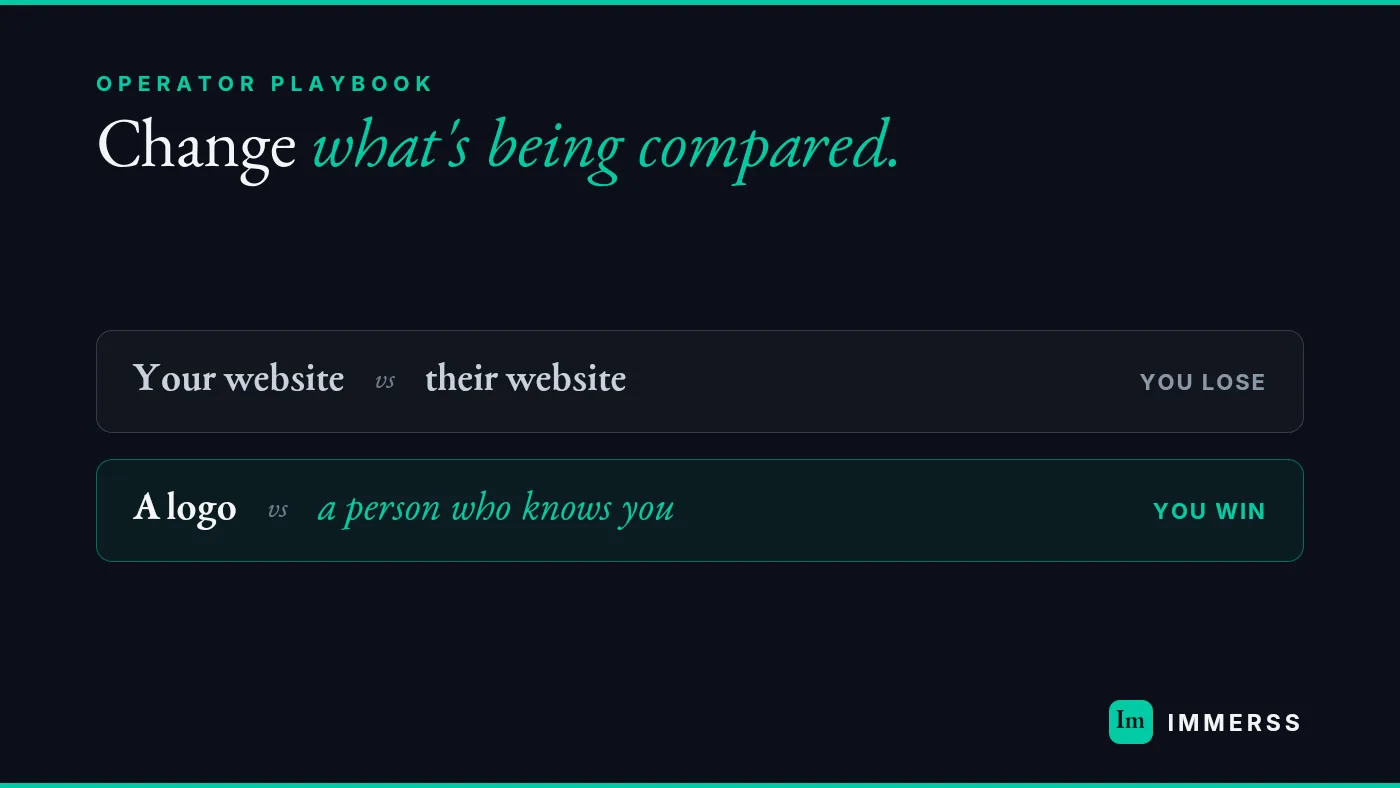
A configurator does not provide any of this. A specifications page does not provide any of this. A chat widget asking about shipping certainly does not. The buyer is looking for category authority — the kind a senior bridal advisor provides in-store — and the standard online surface does not offer it.
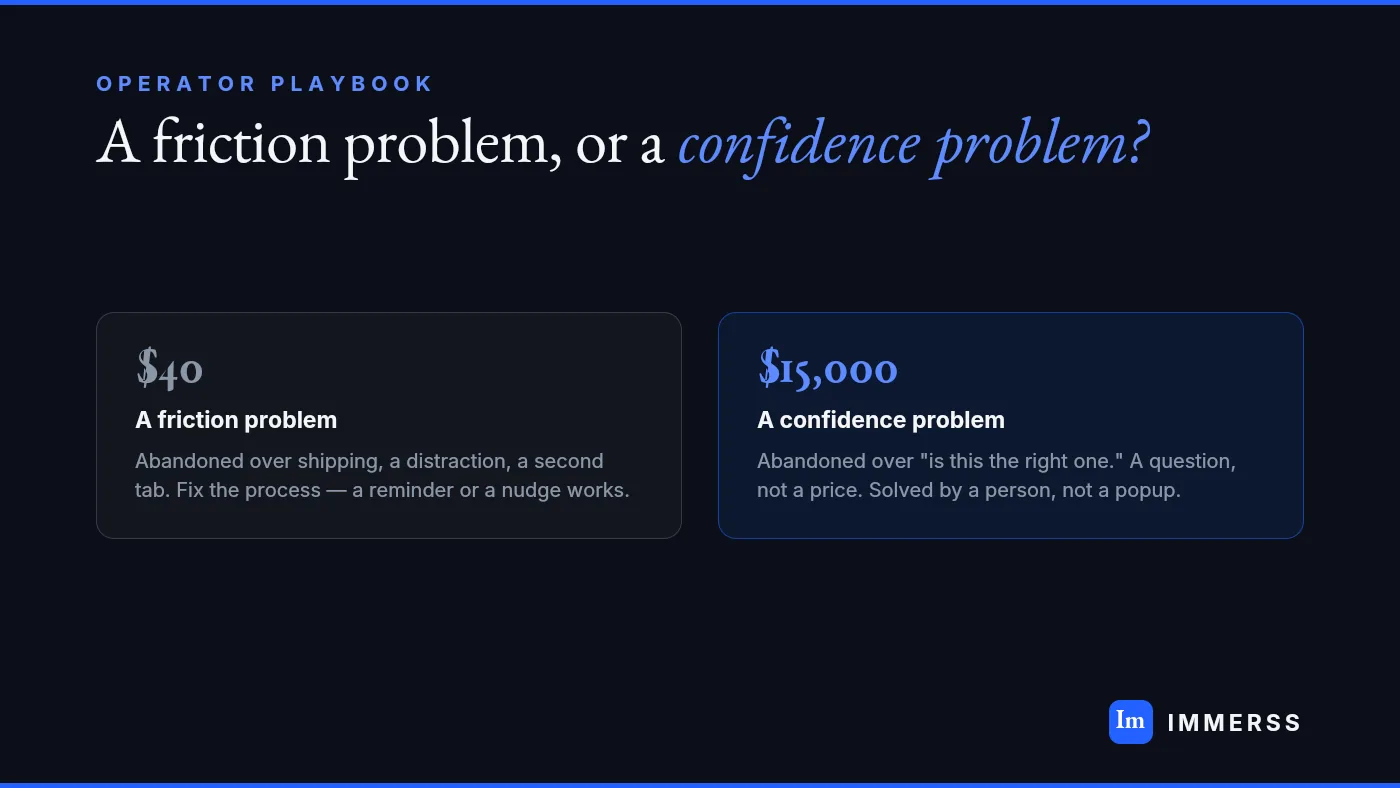
This is the conversion gap. It is not a price problem, a photography problem, or a UX problem. It is an authority problem, and the fix has to address it on those terms.
The Bridal Video Consultation, Structured
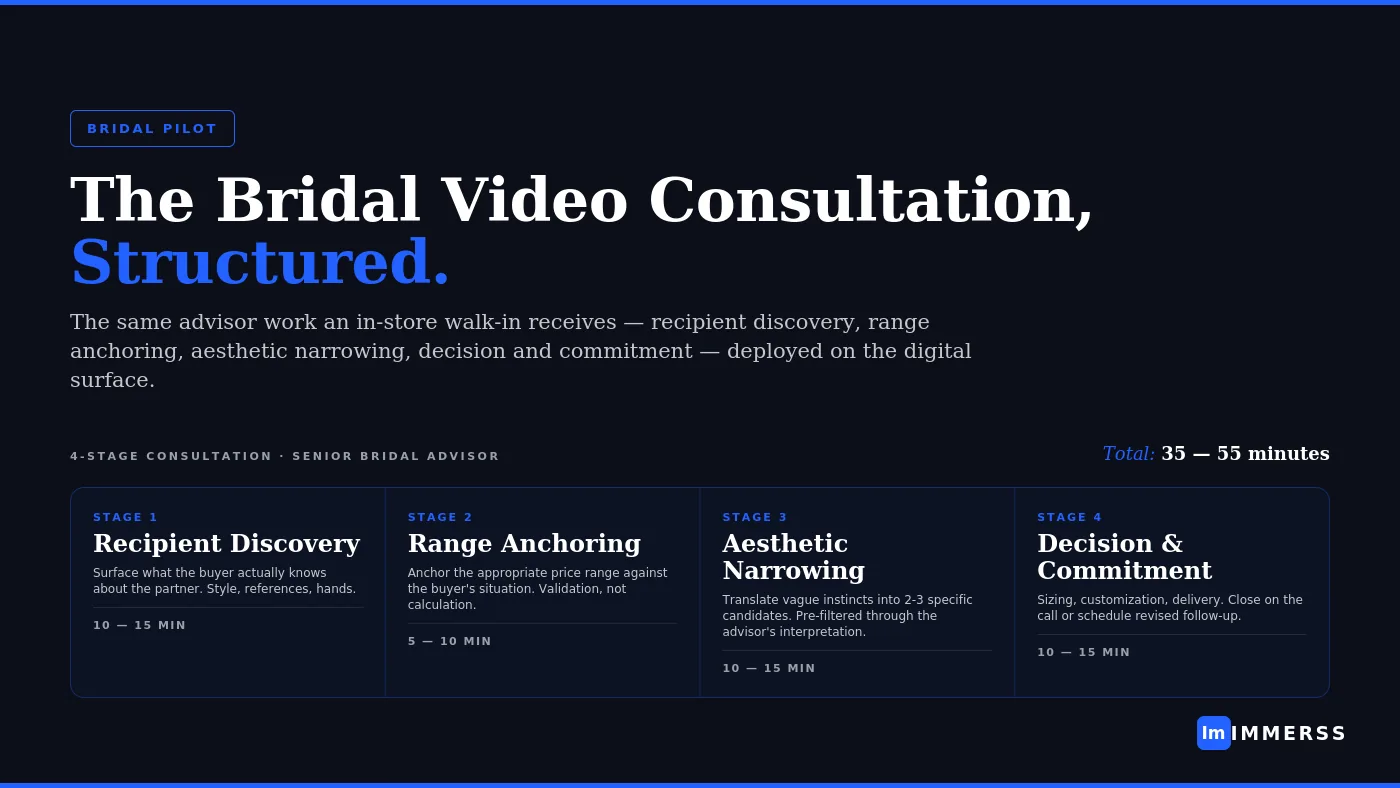
The fix for bridal specifically is to deploy the same advisor work on a video consultation that the operator’s senior bridal staff already does in-store. The structure is consistent across operators running the program competently:
Stage 1: Recipient discovery (10-15 minutes). The advisor surfaces what the buyer actually knows about the partner. What does she wear day-to-day? How does she talk about jewelry? What is her style? Has she ever mentioned a ring she liked? What are her hands like? This stage usually surfaces meaningfully more than the buyer thought they had to share.
Stage 2: Range anchoring (5-10 minutes). The advisor anchors the appropriate price range against what the buyer is comfortable with and what the advisor has seen work for similar relationships at similar price points. The buyer leaves this stage knowing what range is appropriate for their situation, not because the website calculated it, but because someone with category authority validated it.
Stage 3: Aesthetic narrowing (10-15 minutes). Through the recipient discovery and range anchoring, the advisor has built a working model of what the right ring direction is for this couple. The advisor narrows the catalog from hundreds of options to two or three specific candidates, walks the buyer through them on camera, explains the meaningful differences, addresses the buyer’s specific questions.
Stage 4: Decision and commitment (10-15 minutes). The buyer makes a decision on one of the candidates or asks for a follow-up consultation with revised options. The advisor handles sizing questions, customization options, delivery timing, and the close. For confident buyers, the close happens on the call. For buyers who want a day to think, the advisor schedules a follow-up.
Total session length: 35-55 minutes. Close rate on completed consultations clusters meaningfully above the in-store baseline — in part because the buyer who has booked a video consultation has self-qualified more deliberately than a walk-in. AOV runs higher than baseline because the advisor’s recommendations carry trust the configurator cannot generate.
The 60-Day Bridal Pilot Structure
For operators with credible bridal inventory, the structured 60-day pilot is the cleanest way to deploy this for the August-October-onwards search window. The pilot structure:
Week 1-2 — Setup. Integration with the Shopify storefront. AI sales agent configured against the bridal inventory. Brand voice training for the agent’s qualification conversations. Senior bridal advisor scheduling integrated for video consultations.
Weeks 3-6 — Engagement. The agent begins recognizing engagement ring buyer patterns in session signals and routing them toward scheduled consultations. Real consultations begin. Initial close rate, AOV, and conversation pattern data flows back.
Weeks 7-8 — Optimization. Based on engagement data, conversation flow refined. Routing logic tuned. Advisor scheduling optimized for the booking patterns the data reveals. Specific question patterns the buyers are bringing get added to the agent’s qualification logic.
Weeks 9-10 (final report period). Performance against baseline measured. Close rate, AOV, attributable revenue, lead capture rate on previously-bouncing bridal traffic. Decision to scale or refine.
For operators who start the pilot in May or June, the deployment is tuned and running by mid-July to August — exactly in time for the search peak that converts in November-February.
What The Pilot Includes
A structured pilot for the bridal vertical specifically includes:
- AI sales agent custom-trained on the operator’s bridal inventory, brand voice, and category-specific conversation patterns
- Bridal-specific qualification logic — recognition of engagement ring session patterns, routing to senior bridal advisor rather than general booking pool
- Video consultation infrastructure designed for the bridal session structure (longer than standard consultation, comparison-piece capability, secure handling of high-AOV transactions)
- Weekly performance insights specific to bridal — engagement, conversion, AOV lift, lead capture on bridal-category traffic
- Final ROI report with bridal-specific revenue attribution
- Full setup, integration, and ongoing optimization handled by Immerss — no engineering or technical lift on the operator team
Who This Pilot Is Designed For
The operators for whom the bridal pilot makes the most sense share specific characteristics:
- Credible bridal program with senior in-store advisor. The pilot deploys the advisor’s authority online. If the in-store advisor does not exist, the pilot does not work.
- Shopify Plus storefront with meaningful bridal traffic. Most operators with engagement ring inventory have meaningful organic search traffic in this category. The pilot captures the conversion gap on that traffic.
- AOV above $3,000 on engagement ring SKUs. The unit economics are most decisive at higher AOVs, where the value of the senior advisor’s time is recovered easily on a single closed consultation.
- Q4 and Q1 revenue concentration in bridal. Operators who have a meaningful share of annual revenue concentrated in the November-February proposal season are the ones for whom the timing window matters most.
If your business fits this profile, the structured pilot is a low-risk way to find out whether the lever works on your specific bridal traffic, in time for the season that matters most.
The Lead-Time Discipline
The most consistent operator question on this vertical is “is it too late for this year?”
For pilots starting in early May, the answer is clearly no. Sixty days of pilot runs through early-to-mid July, with optimization completing by late July. The deployment is in market for the August-October search peak that converts through Q4 and Q1.
For pilots starting in June, the deployment is in market for the latter portion of the search peak, which captures meaningful Q4 and Q1 revenue but misses some early-season opportunity.
For pilots starting in July or later, the deployment is unlikely to be tuned in time for the converting window. The honest recommendation for these operators is to plan the pilot for the 2027 proposal season, deploy in spring 2027, and run a fully tuned program through that fall and winter.
The 6-10 week deployment-and-optimization timeline is real. Operators who decide quickly get this year. Operators who deliberate get next year.
What To Decide
For independent jewelers, specialty bridal retailers, and high-AOV fine jewelry operators with credible bridal programs:
- Quantify the gap. What is your engagement ring conversion rate online versus in-store on equivalent walk-in traffic? In nearly every operator’s data, the gap is large.
- Identify the senior advisor. Who is the advisor whose authority needs to be deployable on the digital surface? For most independents, this is the owner or longstanding senior associate.
- Decide the deployment timeline. Pilot starting now or in the next four weeks puts you in market for the August-October search peak. Pilot starting later misses the converting window.
The bridal vertical is the highest-stakes underconverted opportunity in fine jewelry online. The operational deployment to capture it is well-understood. The pilot structure removes the commitment risk. The timing window for this year is real and closing.
For operators serious about bridal, this is the lever to pull now.
Immerss is a luxury live commerce platform combining AI sales agents with one-to-one video consultations. Built specifically for fine jewelry operators whose conversion gap is conversational, not technical — and most acutely so in the bridal vertical.
Apply for the 60-day AI Sales Agent pilot: landing.immerss.live For Shopify Plus agencies introducing this to bridal clients: partners.immerss.live