From Cost Center to Revenue Engine: The Complete Guide to Transforming Customer Service
How leading retailers are turning their biggest operational expense into their most powerful competitive advantage.
Executive Summary
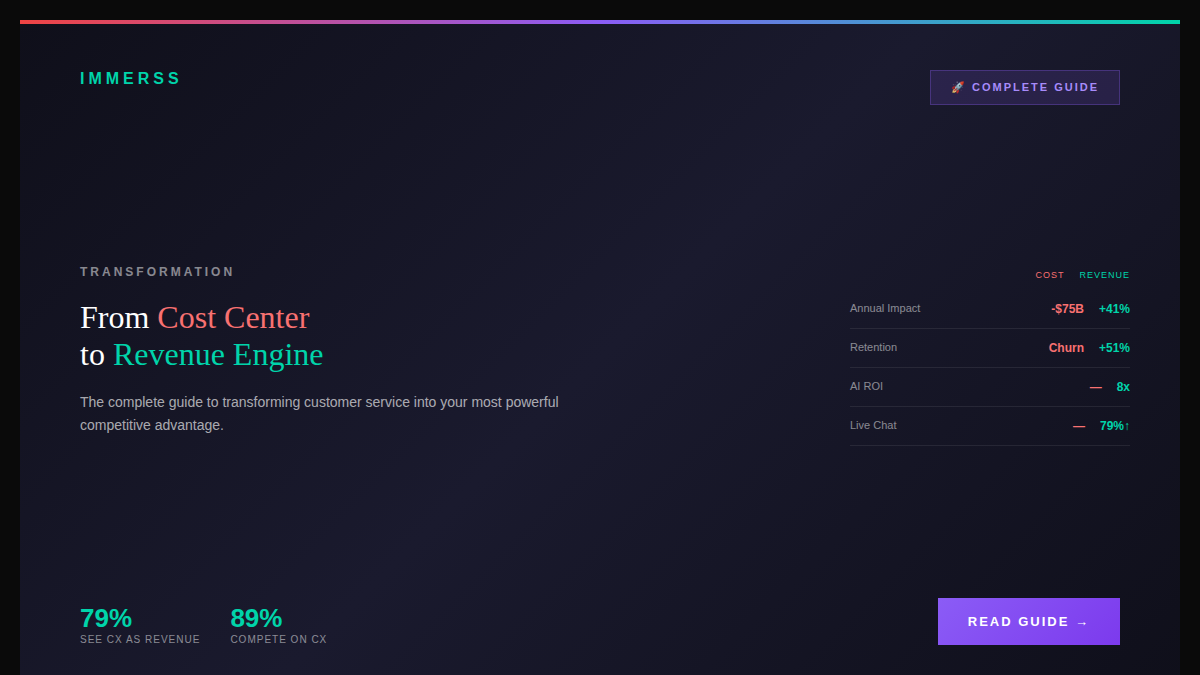
Customer service is undergoing a fundamental transformation. For decades viewed as a cost to minimize, customer service is now recognized as a strategic revenue driver by 79% of companies.
This guide examines the data behind this shift, the technology enabling it, and the practical steps to transform customer service from a cost center to a revenue engine.
Key findings:
- $75 billion lost annually by US companies due to poor customer service
- 41% faster revenue growth at customer-obsessed organizations
- 51% better retention for companies prioritizing customer experience
- 8x ROI from AI-powered customer service systems
- 79% of businesses report sales improvement from live chat
- 40% of service organizations adopting proactive strategies by 2025
Part 1: The Cost Center Problem
The Legacy Model
Traditional customer service operates on a simple premise: minimize cost.
Typical metrics:
- Cost per ticket
- Average handle time
- First-call resolution
- Tickets deflected
- Headcount
Typical behaviors:
- Route to self-service whenever possible
- Minimize human interaction
- Close tickets as quickly as possible
- Outsource to lowest-cost providers
- Measure efficiency over effectiveness
The Result
This model has a predictable outcome:
US companies lose $75 billion yearly due to poor customer service.
That number has remained flat despite massive investment in automation, chatbots, and self-service tools. Why? Because the investments are optimized for cost reduction, not value creation.
Additional impact:
- 73% of customers leave after multiple bad experiences
- 56% of dissatisfied customers don’t complain — they just leave
- 50% say a negative service interaction ruins their entire day
- 85% of consumers will switch to a company with better service
The cost center model creates a vicious cycle: minimize investment → deliver poor service → lose customers → need more investment to replace them.
Part 2: The Revenue Engine Opportunity
The Mindset Shift
Leading companies have recognized a fundamental truth: customer service touchpoints are revenue opportunities.
79% of companies now view customer experience as a revenue driver, not a cost.
This isn’t philosophical — it’s financial:
Customer-obsessed organizations report:
- 41% faster revenue growth than competitors (Forrester)
- 51% better customer retention
- 29% more likely to secure growth funding
- 25 positive emotions evoked for every negative (in elite brands)
Direct Revenue Impact
Live Chat and Real-Time Engagement
79% of businesses report improvement in sales and revenue from live chat implementation.
Why it works:
- Catches customers at peak purchase intent
- Resolves objections in real-time
- Enables product recommendations
- Costs $1 vs $6+ for phone interactions
Proactive Service
Gartner predicts 40% of customer service organizations will adopt proactive strategies by 2025.
Proactive approaches:
- Anticipate customer needs before they ask
- Intervene during cart abandonment
- Reach out on service anniversaries
- Offer assistance during browsing
Impact: Proactive service reduces churn and drives incremental purchases by addressing needs before they become problems.
The Loyalty Multiplier
Three in four consumers will spend more with brands delivering superior CX.
This compounds over time:
- 26% higher likelihood of $1,000+ lifetime value when marketing and service teams align (Klaviyo)
- 82% say consistent service builds trust
- Two-thirds of consumers who believe a business cares about their emotional state become repeat customers
The Personalization Premium
Modern customers expect service that knows them:
- 73% expect personalized experiences as technology advances
- 80% are more likely to purchase from brands offering personalization
- 65% expect tailored interactions based on past behavior
- 55% expect companies to use past interactions to personalize future ones
The gap creates opportunity:
Only 47% of business leaders say their customer experiences are highly personalized.
Companies that close this gap see:
- 20% lift in loyalty (Forrester)
- 15% revenue growth
- 40% higher revenue from personalization vs. competitors
- 50% lower customer acquisition costs (McKinsey)
Part 3: The AI Transformation
Market Context
AI is enabling the transformation from cost center to revenue engine at scale:
Market growth:
- AI for customer service: $12B (2024) → $47.8B (2030) — 25.8% CAGR
- Call center AI: 23.8% CAGR through 2030
- Conversational AI: projected to reach $41.4B by 2030
Adoption:
- 78% of organizations use AI in at least one business function (2025)
- 85% of customer interactions expected to be AI-powered by 2025
- 80% of organizations will integrate generative AI tools by 2025
From Deflection to Revenue
The critical difference is intent:
Cost-Focused AI (the old way):
- Goal: Deflect tickets
- Metric: Cost reduction
- Behavior: Answer questions, close tickets
- Result: Customer frustration, missed sales
Revenue-Focused AI (the new way):
- Goal: Drive revenue
- Metric: Conversion, LTV
- Behavior: Engage, recommend, sell
- Result: Sales, loyalty, growth
The ROI Case
AI-powered customer service delivers up to 8x ROI, returning an average of $3.50 for every $1 invested.
Additional impacts:
- 47% faster issue resolution
- 25% higher first-contact resolution
- $80 billion in contact center cost savings projected by 2026
- 77% of service teams report positive ROI from technology investments
Implementation Reality
The challenge isn’t technology — it’s execution:
- Only 25% of call centers have successfully integrated AI into daily operations
- 75% own AI tools but haven’t fully operationalized them
- 53% of managers cite data security concerns
- 44% report lack of in-house expertise
Success requires more than deploying AI — it requires transforming how the organization thinks about customer service.
Part 4: The Transformation Framework
Step 1: Redefine Success Metrics
Stop measuring:
- Cost per ticket
- Average handle time
- Deflection rate
- Tickets closed
Start measuring:
- Revenue per service interaction
- Conversion from support touchpoints
- Customer lifetime value impact
- Upsell/cross-sell from service
- Retention correlation
- Net revenue influence
Step 2: Deploy Revenue-Focused AI
Not all AI is created equal. Revenue-focused AI Sales Agents differ from support chatbots:
AI Sales Agents include:
- Product recommendation engines
- Proactive engagement triggers
- Objection handling capabilities
- Checkout guidance
- Cross-sell/upsell logic
- Purchase intent detection
Key capabilities to evaluate:
- Does it sell or just answer questions?
- Can it recommend products based on browsing behavior?
- Does it handle objections or just deflect?
- Can it guide customers through checkout?
- Does it engage proactively or wait for questions?
Step 3: Align Teams
The revenue opportunity exists in the gaps between departments:
Break silos between:
- Marketing (acquisition)
- Sales (conversion)
- Service (retention)
Create shared:
- Customer data (single view)
- Goals (revenue, not departmental metrics)
- Campaigns (coordinated outreach)
- Accountability (joint ownership of customer outcomes)
Impact: Brands with aligned marketing and customer service teams are 26% more likely to achieve $1,000+ customer lifetime values.
Step 4: Enable Seamless Handoffs
70% of customers expect anyone they interact with to have full context.
62% believe experiences should flow naturally between physical and digital.
This requires:
- Unified customer profiles
- Context preservation across channels
- Seamless AI-to-human escalation
- No customer repetition
Step 5: Measure and Optimize
Track the transformation:
Leading indicators:
- Engagement rate with AI
- Conversion from AI interactions
- Average order value lift
- Customer satisfaction during AI sessions
Lagging indicators:
- Revenue attributed to service touchpoints
- Customer lifetime value change
- Retention rate improvement
- Net Promoter Score correlation
Part 5: The Competitive Landscape
The Race Is On
This transformation is happening industry-wide:
- 89% of businesses will compete primarily on CX by 2025
- 67% of C-suite executives now understand CX’s business impact
- 67% of companies increasing support technology budgets in 2026
- 70% of C-level support executives investing in AI
- 90% of CX leaders plan to increase self-service spending
First-Mover Advantage
Companies that transform first capture customers frustrated with competitors still running the old model.
The switching data:
- 85% of consumers will switch to a company with better service
- 73% leave after multiple bad experiences
- 56% leave without complaining
Every customer your competitor frustrates is an opportunity for you.
The Cost of Waiting
The gap between leaders and laggards is widening:
- Customer-obsessed companies: 41% faster revenue growth
- Average companies: Flat performance
- Cost-obsessed companies: Losing market share
The longer you wait, the harder it becomes to catch up.
Part 6: Case Studies in Transformation
The Thirdlove Model
Women’s intimates brand Thirdlove transformed service into revenue through a customer hub that:
- Displays personalized “For You” recommendations
- Enables order tracking and management
- Integrates loyalty program
- Provides self-service support
Result: The customer hub generated over $200,000 in revenue in 2025.
The Immerss Approach
Immerss AI Sales Agents embody the revenue engine model:
Instead of:
- Deflecting to FAQ
- Minimizing interaction
- Closing tickets
They:
- Engage proactively based on behavior
- Recommend products
- Handle objections
- Guide toward checkout
- Escalate seamlessly to humans when needed
Customer results:
- Engaged visitors convert at a dramatically higher rate
- Meaningfully higher average order value (Lucchese)
- 24/7 revenue capture
Part 7: Implementation Roadmap
Phase 1: Foundation (Months 1-2)
Actions:
- Audit current service metrics
- Define revenue-focused KPIs
- Evaluate AI Sales Agent platforms
- Identify quick-win opportunities
Deliverables:
- New measurement framework
- Technology selection
- Pilot scope definition
Phase 2: Pilot (Months 3-4)
Actions:
- Deploy AI Sales Agent on high-intent pages
- Train on product catalog and FAQ
- Establish baseline metrics
- Iterate on conversation flows
Deliverables:
- Working AI deployment
- Initial performance data
- Optimization roadmap
Phase 3: Scale (Months 5-6)
Actions:
- Expand to additional touchpoints
- Integrate with CRM and marketing
- Enable proactive engagement
- Align team incentives
Deliverables:
- Full deployment
- Team alignment
- Revenue attribution model
Phase 4: Optimize (Ongoing)
Actions:
- A/B test conversation approaches
- Refine product recommendations
- Expand personalization
- Measure and report revenue impact
Deliverables:
- Continuous improvement
- Executive reporting
- Competitive advantage
Conclusion: The Transformation Imperative
Customer service stands at an inflection point.
The old model — minimize cost, deflect tickets, reduce headcount — leaves $75 billion on the table annually and creates a race to the bottom.
The new model — engage proactively, sell through service, build loyalty — drives 41% faster revenue growth and creates sustainable competitive advantage.
The technology exists. The data is clear. 79% of companies now recognize customer service as a revenue driver.
The question is no longer whether to transform, but how fast.
The companies that move first will capture:
- Customers frustrated with competitors
- Revenue from service touchpoints
- Loyalty that compounds over time
- Market share that’s increasingly hard to reclaim
The companies that wait will face:
- Widening competitive gaps
- Rising customer acquisition costs
- Accelerating churn
- Diminishing returns on service investment
The transformation from cost center to revenue engine isn’t optional. It’s survival.