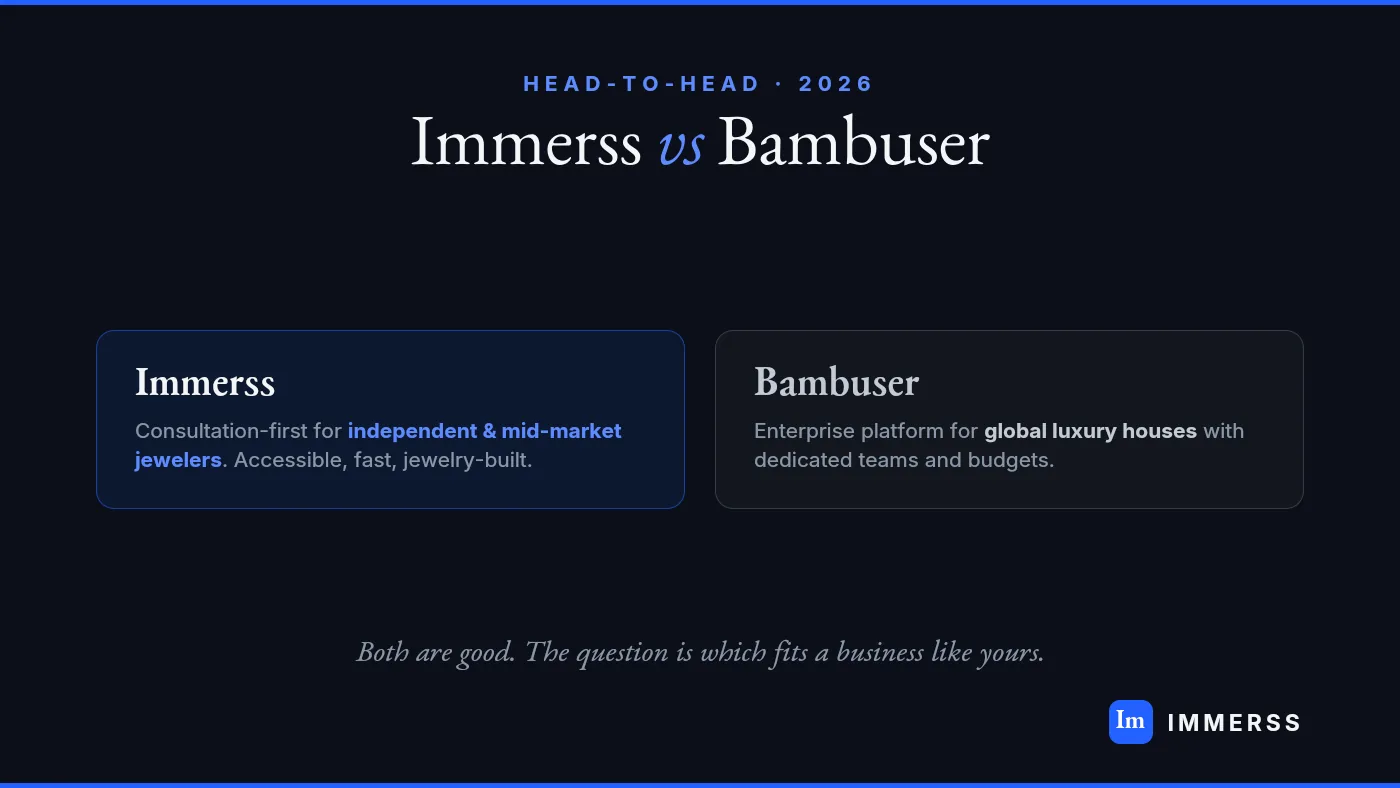
Immerss and Bambuser are both strong video commerce platforms, but they’re built for different businesses. Bambuser is an enterprise platform designed for global luxury houses and large brands with dedicated teams and enterprise budgets. Immerss is a consultation commerce platform focused on independent and mid-market jewelers who want the in-store experience online — affordably and quickly. This comparison breaks down how they differ on model, pricing, implementation, and fit, so you can choose based on which is built for a business like yours.
The short answer: if you’re a global enterprise, Bambuser’s depth is built for you; if you’re an independent or mid-market jeweler, Immerss is built for you. Here’s the detail.
Immerss vs Bambuser: the quick answer
Choose Bambuser if you’re a large enterprise or global luxury house running video commerce across multiple markets with a dedicated digital team and enterprise budget. Choose Immerss if you’re an independent or mid-market jeweler who wants a consultation-first experience (an AI Sales Agent plus live one-to-one video), transparent and accessible pricing, and a fast implementation without an enterprise project. Both deliver high-quality video commerce; the deciding factor is your size, selling model, and budget — not a feature checklist, since both cover the core capabilities, and a checklist can’t see the cost, complexity, or fit behind each checkmark.
What is Bambuser?
Bambuser is an enterprise video commerce platform used by major global brands and luxury houses. It supports live shopping in broadcast (one-to-many), one-to-one, and hybrid formats, with deep customization, enterprise-grade infrastructure and security, and integrations suited to large commerce stacks. Its strengths come from its purpose: serving very large organizations with complex, multi-market operations and the internal teams to run them. Pricing is enterprise and typically quote-based, generally involving a substantial annual commitment plus implementation — appropriate for the scale it serves, and a meaningful consideration for smaller retailers.
What is Immerss?
Immerss is a live commerce platform built for high-AOV retail — fine jewelry, watches, and luxury — with a focus on independent and mid-market retailers. It brings three integrated modules to high-consideration selling: an AI Sales Agent that engages and qualifies high-intent shoppers 24/7; Clienteling — one-to-one Live Co-Shopping where an advisor guides the buyer to a confident purchase, plus Outbound for VIP appointments; and Video Commerce — Live Shopping Events, a Shoppable Video Library, and PDP videos. Together they restore the in-store experience online and keep it Human, Personal, and Measurable. It’s built for the high-consideration, high-trust, five-figure sale, with transparent tiered pricing, a fast implementation, and jewelry-specific capabilities (4K and macro for showing stones, certificate sharing, clienteling). Its strengths come from that focus: the consultation model, accessible cost, and speed to value for a business that isn’t a global enterprise.
Immerss vs Bambuser: comparison table (2026)
| Immerss | Bambuser | |
|---|---|---|
| Built for | Independent & mid-market jewelers, high-AOV retail | Global luxury houses, large enterprises |
| Core model | Consultation-first (AI Sales Agent + live 1:1) | Broadcast, 1:1, and hybrid at enterprise scale |
| Pricing | Transparent tiers (~$800–2,500/mo) | Enterprise / quote-based, substantial + implementation |
| Implementation | Fast (weeks), low overhead | Enterprise project, dedicated team |
| Jewelry focus | Purpose-built (4K/macro, certificates, clienteling) | General video commerce, many verticals |
| Best fit | Mid-market jeweler wanting in-store experience online | Global brand running multi-market video commerce |
| Try it | 60-day pilot, on us | Enterprise sales process |
Pricing and capability descriptions are directional, drawn from each platform’s general positioning; confirm current details with each vendor.
How do Immerss and Bambuser differ?
The core difference is who each is built for, which shows up across four dimensions. Model: Immerss centers on the consultation — the one-to-one guided sale that closes high-AOV jewelry — while Bambuser is a broader enterprise platform spanning broadcast and one-to-one at scale. Scale and cost: Bambuser is built for global enterprises and priced accordingly; Immerss is built for independents and mid-market retailers with transparent, accessible pricing. Implementation: Immerss is designed to get a jeweler live in weeks with low overhead; an enterprise deployment is a larger, longer project. Focus: Immerss is purpose-built for jewelry and high-AOV retail, while Bambuser serves many verticals and very large brands. None of these is a knock on Bambuser — they’re differences in fit.
The practical way to read these dimensions is that they all flow from one decision each platform made about its customer. Bambuser optimized for the global enterprise, so it has the depth, customization, and scale that customer needs — and the cost, complexity, and implementation that come with serving it. Immerss optimized for the independent and mid-market jeweler, so it has the consultation focus, accessible pricing, and speed that customer needs — and deliberately doesn’t carry the enterprise overhead that customer doesn’t. Neither set of trade-offs is wrong; they’re aimed at different businesses. The mistake is choosing the platform whose trade-offs were made for someone else.
Which is better for an independent or mid-market jeweler?
For an independent or mid-market jeweler, Immerss is generally the better fit, because it delivers exactly what that business needs without the cost and complexity of an enterprise platform. Independents need to bring the in-store consultation experience online, convert high-AOV buyers through guided video, and do it affordably and quickly — which is precisely what Immerss is built around. An enterprise platform can do one-to-one video too, but accessing it typically means enterprise pricing, a longer implementation, and capabilities for scale the jeweler won’t use. For most of the market, the right-sized, consultation-first platform converts better than the more powerful enterprise tool, because all of its capability is aimed at their business. There’s also a quieter advantage: a platform built for independents tends to be run by the jeweler’s own team without specialist help, which keeps both cost and friction low and means the people closest to the customers are the ones operating the experience. (See the broader best live shopping platforms for jewelry comparison.)
Which is better for a global luxury house or enterprise?
For a global luxury house or large enterprise, Bambuser is a strong and appropriate choice. Organizations running video commerce across many markets, with dedicated digital teams, complex tech stacks, and enterprise security and customization requirements, will use the depth that Bambuser is built to provide — and that depth is worth its cost at that scale. The enterprise capabilities that are overkill for an independent jeweler are exactly right for a multi-market global brand. Fit runs both ways: the same features that make Bambuser the wrong choice for a small jeweler make it the right choice for a global house.
How much do Immerss and Bambuser cost?
Immerss uses transparent tiered pricing in the range of roughly $800–$2,500 per month depending on tier, with a fast, low-overhead implementation. Bambuser uses enterprise, quote-based pricing that typically involves a substantial annual commitment plus implementation fees, reflecting the scale and customization it serves. For an independent or mid-market jeweler, the total cost of an enterprise platform — license, implementation, and the internal team to run it — is usually the decisive factor, since the accessible, consultation-first option delivers the needed outcome at a fraction of the all-in cost.
Is there a Bambuser alternative for high-AOV jewelry?
Yes — Immerss is a Bambuser alternative built specifically for high-AOV jewelry and the independent-to-mid-market retailer. Where Bambuser is an enterprise platform serving many verticals, Immerss focuses on the consultation model for fine jewelry, watches, and luxury, with jewelry-specific features, accessible pricing, and fast implementation. Jewelers evaluating Bambuser who find the enterprise scale and cost larger than they need typically find Immerss is sized for exactly their business.
Worked example: the true cost of fit
Here’s a calculation you can redo with your own numbers, comparing not feature counts but the all-in cost and time-to-value for a mid-market jeweler.
- Consultation-first platform (right-sized): ~$1,500/mo license, live in ~3 weeks, run by your existing team. In month one you’re already converting high-AOV buyers through consultation. First-year platform cost ≈ $18,000, with revenue starting in week three.
- Enterprise platform (over-sized): a substantial annual license plus a five-figure implementation, live in ~3 months, requiring dedicated internal resource to operate. Even setting license aside, the implementation and the lost quarter of selling are real costs — three months at, say, even a handful of recovered high-AOV sales per month is six figures of deferred revenue.
The point isn’t that one platform is cheaper per feature; it’s that fit determines total cost and speed to results. For a business that isn’t a global enterprise, the right-sized platform wins on the only math that matters — sales closed per dollar and per week. The deferred-revenue cost of a slow implementation alone often exceeds the entire annual license of a right-sized platform, which is why time-to-value, not feature count, should anchor the comparison. Swap in your own license, implementation, and ramp assumptions, and the picture usually points the same way for a mid-market jeweler.
Is your store a fit for the consultation-first model?
Run this filter:
- Shopify Plus, 50K+ monthly visits, AOV $500+ (decisive at $5,000+).
- You’re an independent or mid-market jeweler — not a global multi-market house.
- You want to move fast and avoid a months-long enterprise implementation.
- Your high-value sales are won through guidance and relationships, not broadcast reach.
If two or more are true, the consultation-first platform is likely your fit. (See where your store stands on the benchmarks.)
What to measure when evaluating either platform
Evaluate on outcomes, not feature counts:
- Consultation conversion rate on qualified high-AOV buyers.
- Time-to-value — weeks until you’re live and measuring results.
- Total cost of ownership — license + implementation + internal team.
- Full-price AOV on assisted sales and repeat rate of consultation customers.
A feature comparison will tell you which platform can do the most; these four tell you which one will actually move your business. If a platform scores high on capability but poor on time-to-value and total cost of ownership for a store your size, that’s the fit problem the spreadsheet was hiding.
The 60-day pilot, on us
The best way to evaluate fit is to run the consultation model on your own inventory and measure it. That’s what the pilot is for.
We run a structured 60-day pilot, on us — an AI Sales Agent engaging and qualifying high-intent jewelry shoppers, live one-to-one video consultation as the selling mechanism, and measurement around consultation conversion, full-price AOV, and time-to-value. You change no platform and risk no margin to see whether the consultation-first model fits your store. The clearest way to judge it is against your own catalog — book a demo and the team will map the right combination of AI Sales Agent, Clienteling, and Video Commerce to your brand. (For how the AI piece works, see the guide to AI sales agents.)
See the pilot for merchants: landing.immerss.live Agency partner program: partners.immerss.live
Immerss is a luxury live commerce platform — AI Sales Agents and one-to-one video consultation for fine jewelry, watches, and high-AOV retail, built on Shopify Plus.