E-Commerce Value Proposition Strategy: Building Differentiation in a Commoditized Market
How to craft a value proposition that addresses the trust gap and drives conversion.
The Strategic Challenge
E-commerce brands face an increasingly difficult differentiation problem. Product selection is vast, prices are transparent, and shipping is fast everywhere. The traditional value proposition pillars — selection, price, convenience — have become table stakes rather than differentiators.
For brands selling high-consideration products — jewelry, furniture, electronics, luxury goods — this commoditization pressure is compounded by a fundamental trust gap: customers cannot experience products before purchase.
This analysis presents a framework for building e-commerce value propositions that address these challenges and create sustainable differentiation.
Understanding Value Proposition Structure
Definition
A value proposition is a clear statement that articulates:
- Target audience: Who you serve specifically
- Core benefit: What outcome you deliver
- Differentiation: Why you’re uniquely positioned to deliver it
The Four Levels
Effective value proposition strategy operates across multiple levels:
Level 1: Primary (Company-Wide) The overarching promise that defines your brand across all touchpoints.
Level 2: Segment-Specific Tailored messaging for distinct customer groups with different needs and motivations.
Level 3: Product-Specific Value propositions for individual products or product categories.
Level 4: Process-Specific Differentiation based on how you deliver value, not just what you deliver.
The E-Commerce Trust Gap
The Problem
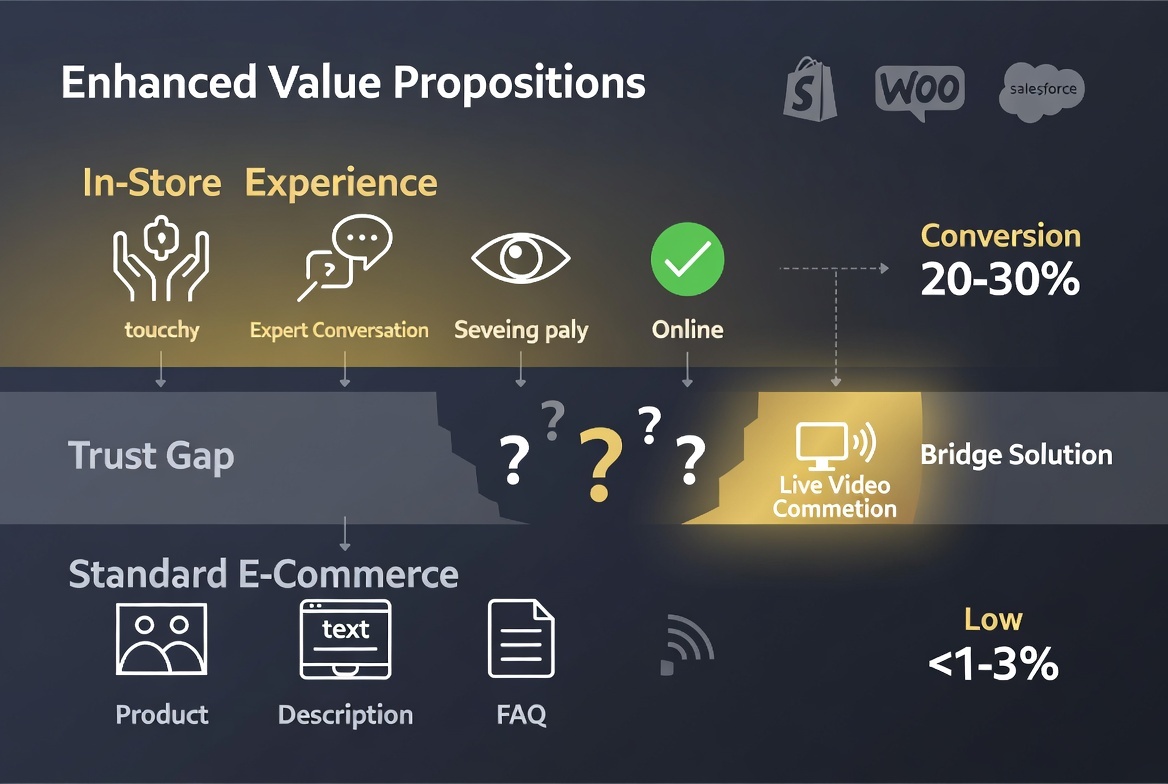
E-commerce conversion rates reveal a significant structural challenge:
| Channel | Average Conversion Rate |
|---|---|
| In-store retail | 20-30% |
| General e-commerce | 2-3% |
| Online jewelry | <1% |
The gap between in-store and online conversion for high-consideration products represents billions in unrealized revenue.
Root Cause Analysis
The trust gap stems from the absence of experiential elements that drive confidence in physical retail:
Missing in standard e-commerce:
- Tactile product experience
- Real-time visual assessment (lighting, scale, detail)
- Expert guidance and Q&A
- Social validation (seeing others’ reactions)
- Immediate reassurance for concerns
Standard e-commerce compensations:
- Product photography (limited by static nature)
- Written descriptions (cannot answer specific questions)
- Reviews (generic, not personalized)
- Return policies (shift risk but don’t build confidence)
These compensations reduce friction but don’t build the confidence necessary for high-consideration purchases.
Value Proposition Framework for High-Consideration E-Commerce
Core Template
“We help [specific audience] [achieve specific outcome] through [unique mechanism], ensuring [confidence-building element] that [alternative] cannot provide.”
Application by Component
Audience specificity: Not: “jewelry shoppers” But: “couples choosing engagement rings” or “gift-givers selecting anniversary jewelry”
Outcome focus: Not: “buy jewelry” But: “find pieces they’ll love with confidence”
Unique mechanism: Not: “great selection and service” But: “live video consultations with certified experts”
Confidence element: Not: “easy returns” But: “see every detail in real light and get your questions answered before you buy”
Alternative comparison: Not: “better than competitors” But: “something product photos and chatbots cannot provide”
Example Implementation
Generic e-commerce value proposition: “Beautiful jewelry, great prices, free shipping.”
Enhanced value proposition: “We help you find jewelry you’ll love through live video consultations where certified experts show you pieces in real light, answer your specific questions, and guide your decision — so you buy with confidence, not hope.”
Integrating Live Commerce into Value Propositions
Strategic Rationale
Live video commerce directly addresses the trust gap by providing:
- Real-time product visualization
- Expert guidance and Q&A
- Personalized recommendations
- Human connection and reassurance
These elements transform the value proposition from transactional (“we sell products”) to experiential (“we help you choose with confidence”).
Implementation with Immerss
Immerss enables one-to-one video consultations that become a core element of the value proposition:
Technical capabilities:
- High-quality video product demonstration
- Integrated checkout within consultation
- Expert matching based on product category
- Cross-platform availability (Shopify, WooCommerce, Salesforce)
Value proposition enhancement:
- “See products in real light before you buy”
- “Get expert answers to your specific questions”
- “Connect with specialists who understand your needs”
- “Buy with the confidence of an in-store experience”
Value Proposition Examples by Segment
For engagement ring buyers: “Choosing an engagement ring is one of the most important purchases you’ll make. Our certified gemologists guide you through live video consultations where you’ll see rings in natural light, understand the differences that matter, and find the perfect ring with confidence.”
For luxury watch buyers: “Through live video consultations with our watch specialists, you’ll see timepieces in motion, understand the craftsmanship up close, and get expert guidance on finding the perfect watch for your collection.”
For furniture buyers: “See furniture in real-world scale, understand fabric textures and colors accurately, and get design guidance from our interior specialists — all through live video consultations that make online furniture shopping as confident as in-store.”
Value Proposition Deployment Strategy
Touchpoint Integration
The value proposition should appear consistently across:
Primary touchpoints:
- Homepage hero section
- Category page headers
- Product page value blocks
- Checkout reassurance elements
Secondary touchpoints:
- Advertising creative
- Email marketing
- Social media content
- Customer service scripts
Messaging Hierarchy
Tier 1: Core promise (5-10 words) “Expert guidance through live video consultations”
Tier 2: Expanded benefit (1-2 sentences) “Connect with certified experts via live video to see products in real light and get your questions answered before you buy.”
Tier 3: Full value proposition (paragraph) Complete articulation with audience, benefit, mechanism, and differentiation.
Tier 4: Supporting proof points
- Specific expert credentials
- Customer testimonials
- Conversion/satisfaction data
- Process details
Measuring Value Proposition Effectiveness
Primary Metrics
Conversion rate by channel: Track conversion rates for customers who engage with live consultations vs. standard checkout path.
Average order value: Measure whether value proposition messaging correlates with higher purchase values.
Return rate: Confident purchases should result in fewer returns — track this correlation.
Customer acquisition cost: Differentiated value propositions should improve ad efficiency.
Qualitative Indicators
Customer feedback: Survey customers about what influenced their decision.
Objection patterns: Track sales objections — effective value propositions reduce common concerns.
Competitive win/loss: Understand why customers choose you vs. alternatives.
Testing and Optimization
A/B Testing Framework
Test elements:
- Headline variations (benefit-led vs. mechanism-led)
- Audience specificity levels
- Differentiation emphasis
- Proof point types
Test locations:
- Homepage hero
- Product page value blocks
- Ad creative
- Email subject lines
Iteration Process
- Baseline measurement: Establish current conversion metrics
- Hypothesis development: Identify value proposition weaknesses
- Variant creation: Develop alternative messaging
- Testing: Run controlled experiments
- Analysis: Evaluate statistical significance
- Implementation: Deploy winning variants
- Repeat: Continuous optimization
Conclusion
In commoditized e-commerce markets, differentiation increasingly depends on value propositions that address the trust gap inherent in digital shopping.
For high-consideration products, this means moving beyond transactional promises (selection, price, convenience) to experiential promises (guidance, confidence, expertise).
Live video commerce provides the operational capability to deliver on these enhanced value propositions. Platforms like Immerss enable brands to promise — and deliver — the expert guidance and real-time product experience that builds purchase confidence.
The formula is straightforward:
Identify the trust gap → Build operational capability to address it → Articulate the promise clearly → Deliver consistently
Brands that execute this formula create sustainable differentiation that competitors cannot easily replicate.
Ready to enhance your e-commerce value proposition with live video consultations? Schedule a Demo with Immerss