For CFOs evaluating a live video sales investment proposal — whether brought forward by an internal team or pitched by an external vendor — the standard digital investment frameworks produce misleading conclusions. The labor model is different. The unit economics are different. The payback structure is different. Applying conventional ecommerce diligence directly will either reject investments that would have worked or approve investments with assumptions that fall apart in execution.
This piece is the practical due diligence framework. It walks through the unit economics that actually matter, the questions to ask of any proposal, the financial modeling structure, the failure modes to watch for, and the scaling decision criteria.
The Core Financial Unit
Every other metric in a live video sales program rolls up into one financial unit: marginal contribution per advisor hour. Track this number, optimize against it, base scaling decisions on it.
It is constructed as:
| Component | Definition | Typical Range (High-AOV) |
|---|---|---|
| Close rate | % of completed consultations that convert to purchase | 25-50% |
| AOV on assisted | Average order value on assisted sessions | 20-50% above baseline |
| Sessions / hour | Senior advisor capacity utilization | 2-4 sessions/hr |
| Loaded advisor cost | Fully-loaded hourly labor cost | Operator-specific |
| Platform amortization | Tooling cost per advisor hour | Operator-specific |
Marginal contribution / advisor hour = (close rate × AOV × sessions/hour × gross margin) − (loaded labor + platform + direct sales costs)
For most high-AOV operators running the program competently, this number is positive and meaningful. The interesting financial questions then become about scaling — how much advisor capacity to deploy, how to drive demand toward the channel, how to sequence investment.
Questions To Ask Of Any Proposal
A short diligence checklist that surfaces the right concerns in any live video sales investment review.
On the close rate assumption: What is the projected close rate on completed consultations, and what is the basis for the projection? The answer should be either operator-specific historical data (from a prior pilot or comparable channel) or rigorous benchmark data from operators in the same category at similar AOV. Vendor marketing material or aspirational targets are not acceptable inputs.
On the AOV lift assumption: What is the projected AOV on assisted sessions versus baseline AOV? The lift assumption should be conservative for the model and aggressive for the revenue case. If the financial model assumes a small lift but the strategic case requires a large lift, that misalignment is the most common red flag in this category.
On the labor cost assumption: What is the fully-loaded cost of the advisor hour, including base compensation, benefits, training time, idle time during ramp, and pre/post-session admin? The right number is the burdened cost, not the salary or contract rate. Programs that model labor cost at the salary level systematically understate the true unit economics.
On the utilization curve: What is the assumed utilization trajectory over the first 90 days, and what is the contingency plan if utilization underperforms? The right answer is either a flexible staffing model that allows capacity to be reduced, or a clear demand-generation investment to fill the capacity. Neither answer alone is sufficient — the proposal needs to address both the cost-side and demand-side responses.
On the measurement framework: What metrics define success or failure at the end of the pilot or initial deployment phase? The thresholds should be defined in advance, the measurement methodology should be explicit, and the off-ramp should be clean if the program does not perform. This is normal financial discipline applied to a non-standard investment, and its absence is a warning sign.
The Payback Period Structure
The structure of payback in live video sales is different from conventional ecommerce technology investment. The model needs to reflect this.
Conventional ecommerce technology investment has payback dominated by recovering large upfront integration costs, with marginal revenue lift accruing against a fixed labor base. Payback periods typically run 2-4 quarters for well-executed programs.
Live video sales has payback dominated by reaching effective capacity utilization on the advisor staffing deployed. The upfront technology investment is much smaller (modern platforms are largely turnkey). The bulk of the cost is variable advisor labor that scales with utilization.
This restructures the payback math:
- Operators reaching effective utilization within 60-90 days see payback inside the first quarter of full deployment
- Operators struggling with utilization see payback stretch out indefinitely regardless of close rate or AOV performance
- The largest financial variance in the program is therefore utilization, not close rate or AOV
This is why pilots are the right financial structure for entering the category. A 60-day pilot is the cleanest way to measure the actual utilization curve on the operator’s specific traffic, retire the variance, and finance the scaled deployment with conviction.
The Failure Modes To Avoid
A few specific operational failures show up consistently in operators who tried live video sales and concluded the financials did not work. Each is avoidable, and each maps to a specific CFO-level diligence point.
Wrong measurement baseline. Comparing live video close rate against generic ecommerce conversion benchmarks. The right comparison is against in-store close rate. Live video reliably approaches and frequently exceeds in-store performance for high-AOV categories. Comparing it against generic ecommerce makes the program look unfavorable against the wrong yardstick.
Wrong staffing seniority. Programs staffed with junior associates or general support agents see materially lower close rates and AOVs. The model only works with genuinely senior advisors capable of making real recommendations on a video call. This is a labor cost reality, not an optimization opportunity.
Overoptimistic ramp curve. Models that assume peak utilization from week one frequently underbudget the ramp period. The actual utilization climbs over 60-90 days as demand routing matures. CFOs should stress-test the model against a 50% utilization assumption for the first two months and verify it still produces acceptable economics.
Capacity overprovisioning. Deploying advisor capacity ahead of demand. Idle advisor hours destroy the unit economics fastest. The discipline is to scale capacity in response to measured demand rather than in anticipation of projected demand.
Wrong financial framework. Applying standard ecommerce LTV/CAC math without adjustment. The advisor labor input breaks the standard framework’s assumptions. The program needs to be modeled on marginal contribution per advisor hour, not on conversion rate lift through a fixed labor base.
The Strategic Context
The piece that sometimes gets lost in unit economics diligence: for high-AOV categories specifically, the strategic stake of live video sales is larger than conversion lift.
In-store has historically been the highest-margin channel for fine jewelry, watches, and adjacent categories. The economics of relationship-led selling — high close rates, high AOVs, real trust — have been the structural reality of these businesses for as long as digital has existed.
Live video sales is the first digital format that produces comparable margin economics. The close rates approach in-store. The AOVs approach in-store. The labor model is leaner than physical retail. The capacity efficiency is higher than traditional clienteling.
The strategic question for the CFO is not whether the program is a marginal conversion lever. The strategic question is whether this is the channel that finally lets the business operate digital at in-store margin economics, and what that means for the long-term margin trajectory.
For most high-AOV operators, the honest answer is yes. The operators who deploy correctly first compound the margin advantage for several years before the category catches up.
What CFOs Should Approve
For finance leaders at high-AOV operators evaluating a live video sales proposal, the disciplined position is to:
-
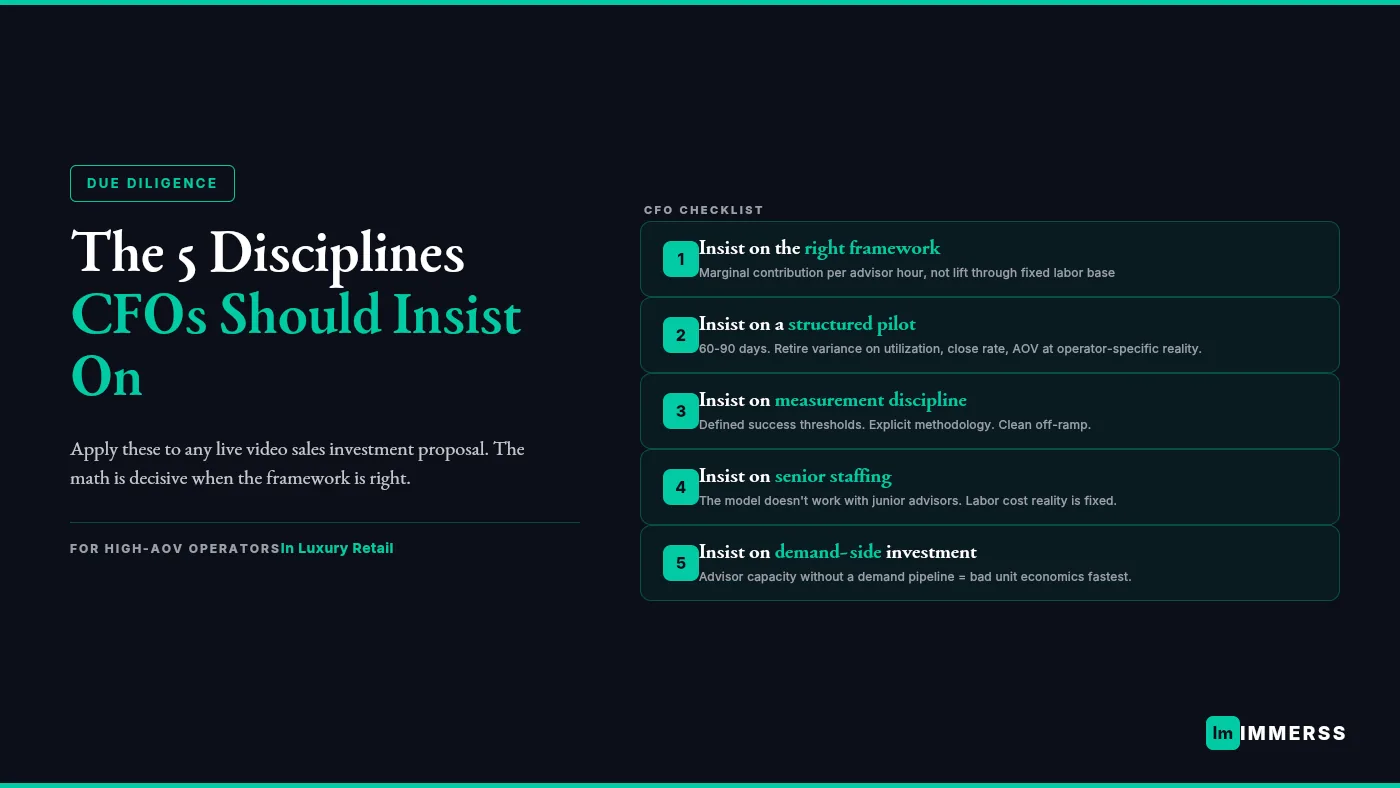
Insist on the right financial framework. Marginal contribution per advisor hour, not conversion lift through a fixed labor base.
-
Insist on a structured pilot before scaled deployment. 60-90 days is the right length to retire variance on utilization, close rate, and AOV at operator-specific reality.
-
Insist on measurement discipline. Defined success thresholds, explicit measurement methodology, clean off-ramp if performance does not materialize.
-
Insist on senior staffing. The program does not work with junior advisors. The labor cost reality is fixed.
-
Insist on demand-side investment paired with supply-side investment. Advisor capacity without a demand pipeline is the fastest path to bad unit economics.
When these disciplines are applied, the math on live video sales for high-AOV categories is decisive in favor of investment. The variance gets retired in the pilot. The scaled deployment gets financed against measured rather than projected performance. The program contributes to the margin profile of the business in ways that the conventional ecommerce surface structurally cannot.
That is the playbook. The numbers, when run correctly, do the work.
Immerss is a luxury live commerce platform combining AI sales agents with one-to-one video consultations. Built for high-AOV operators who need digital margin economics that approach the in-store channel. Book a demo to walk through the unit economics on your specific catalog and traffic.